My Fair Lady (Original Australian Production)
With the Show-curtain down, Musical Director Gabriel Joffe on the conductor's podium, with baton poised to lead the J. C. Williamson Orchestra into "God, Save the Queen", an announcement was made to the audience. "Ladies and Gentlemen. Due to the extreme heat, we wish to advise, gentlemen may remove your jackets."
Melbourne was in the middle of an extreme heatwave in January 1959 and it was also in the middle of My Fair Lady mania! The original cast recording sold thousands of copies. Shop windows featured, "My Fair Lady hats". Smart tea rooms in town were presenting My Fair Lady afternoon teas. Dress boutiques featured black and white dresses in their windows in a nod to the Ascot scene from, yes, My Fair Lady! It was the biggest promoted production to date and Melbourne was My Fair Lady mad! The leadup to opening night was immense. Playing the Broadway cast album on the radio until the official release date was banned. 24 January 1959 at Her Majesty's Theatre and the crowds were building and building. Not only those who had actually come to see the show, but also onlookers keen to get a gander at the stars and celebrities who would be in attendance, and at the stars of the show themselves. They'd already appeared in the Australian Women's Weekly, Post and the like. If we could just get a look at one of them entering the Stage Door! The press was full of anything that involved My Fair Lady.
Sir Frank Tait, managing director of J. C. Williamson's, had bought the Australian rights while he was in New York in 1956 and it took two years to organise the production at a cost of $150,000. The show would run a total of four and a half years.
-2.jpg) John MacCallum with Bunty Turner and the board members of JCW, including Sir Frank and Lady Viola Tait at the centre back.
John MacCallum with Bunty Turner and the board members of JCW, including Sir Frank and Lady Viola Tait at the centre back.
Australian favourite Max Oldaker had understudied Rex Harrison during the London run, as well as playing the role of Zoltan Karpathy, and it was thought he would be the natural choice for the role of Henry Higgins, but it was given to the suave English actor Robyn Bailey. Beautiful and enchanting Bunty Turner had been plucked from the stage in Ireland, at the age of 22, to play Eliza Doolittle! Richard Walker, well known to Australian audiences already for his roles in Gilbert and Sullivan comic operas, was cast as the larrikin Alfred P. Doolittle and English veteran Kenneth Laird finished the leads as Colonel Pickering! David Gray played Freddy, Ailsa Grahame was Mrs. Higgins, Lily Moore, Mrs. Pearce and Stuart Wagstaff, played Karpathy, finishing off the principals. Stuart was also brought in to understudy the role of Higgins and went on with the original Eliza understudy, Patricia Hemingway, for one week in March. The news made the front page of all the papers, it was of such public interest! Patricia left the show not long after for personal health reasons and young Geraldene Morrow was brought over from Perth to take over the Eliza cover. Stuart would go on to play Higgins full-time later in the Australian tour. One interesting fact was Geraldine Ward who played the duel roles of harsh cockney Mrs Hopkins and the elegant Lady Boxington in the Ascot scene, was the only cast member who never missed a single performance in her years with the show!
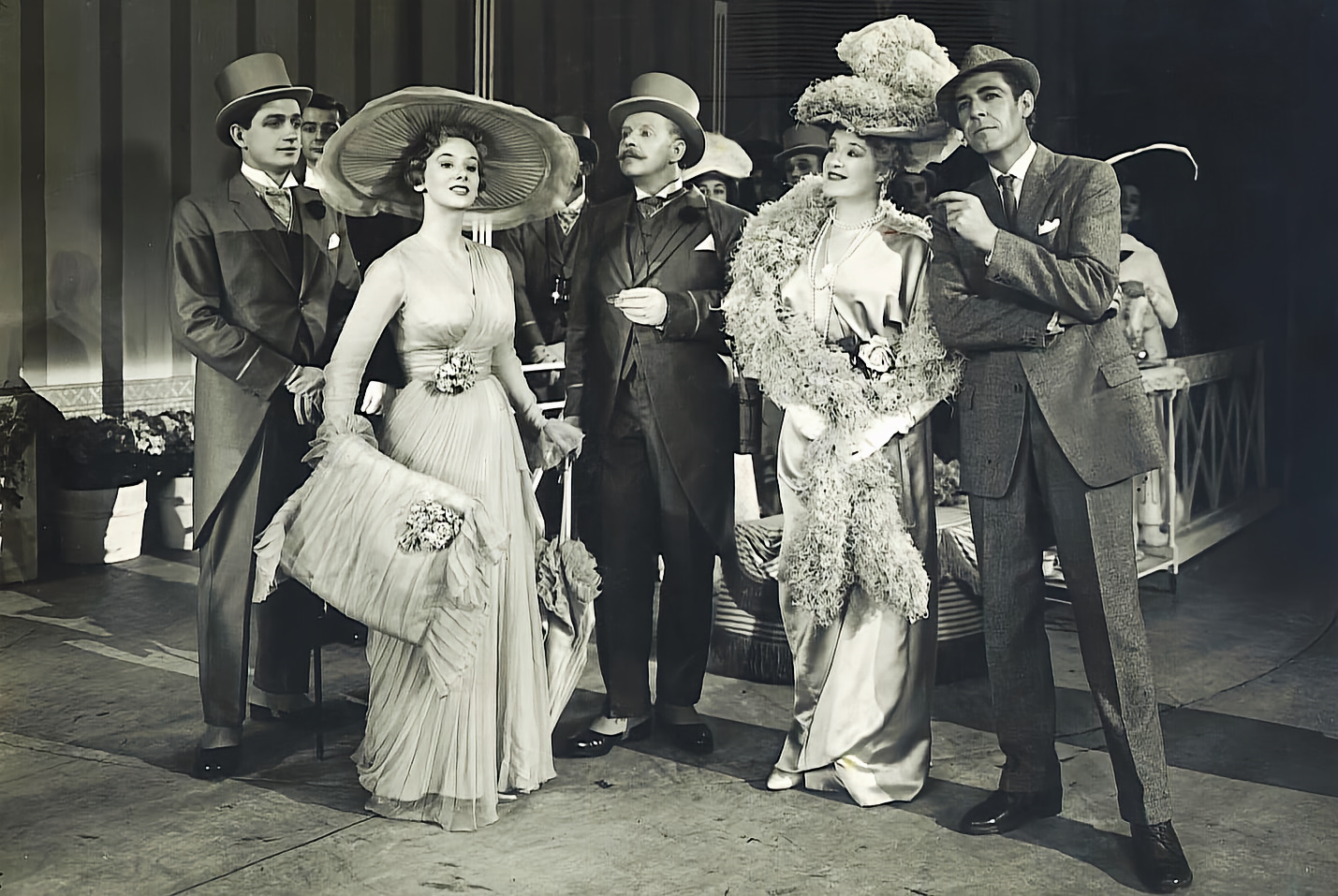 The Ascot scene with Freddy, Eliza, Col. Pickering, Mrs. Higgins and Henry Higgins (Australian Performing Arts Collection, Arts Centre Melbourne)
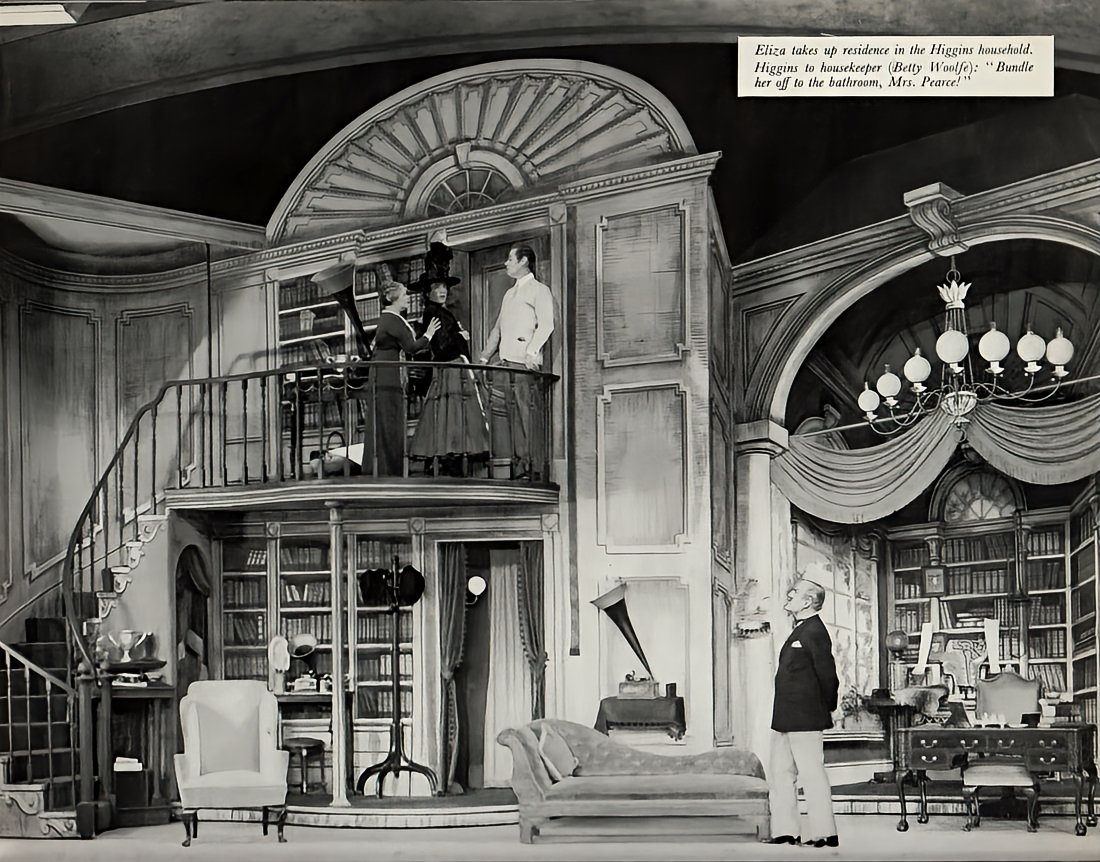
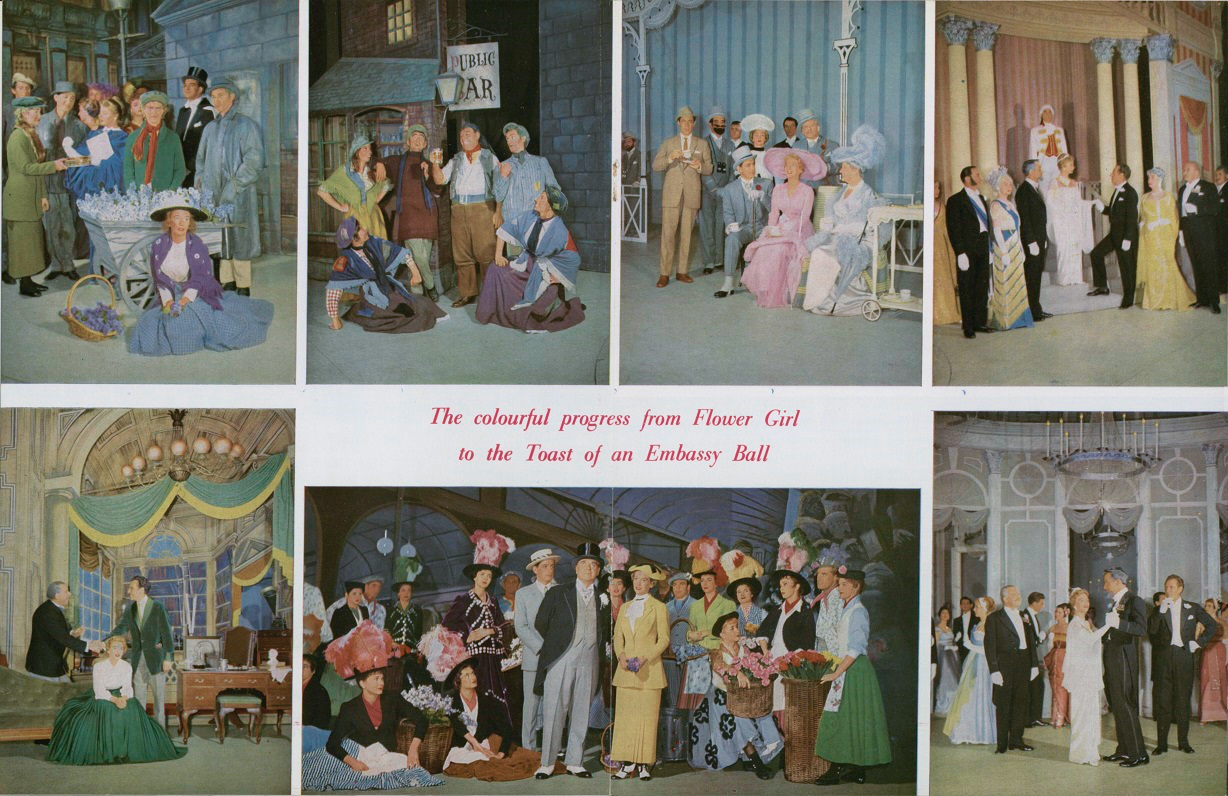
From the moment the orchestra played the opening eight staccato notes of the Overture, the audience was enthralled. They gave the opening scene, as the lights came up behind the London scene gauze, the cast in exaggerated poses, thunderous applause. Again and again at the conclusion of each number, particularly the transitions from one scene to another, on not one but TWO revolves. Each scene change was seamless. From the tenement on Tottenham Court Road splitting in two on the twin revolves, as the reverse side with Henry Higgins' Wimpole Street study swinging into position. They went mad for "The Rain In Spain"! The Ascot scene, with its startling reveal, the black and white costumes, massive hats and exaggerated poses from the female members of the ensemble brought more applause. (So large were the Ascot hats, which had wigs attached for the quick change, that a room was dedicated to them for the girls to dress in.) Bunty Turner appeared at the top of the staircase in Higgins' study dressed in a white, Edwardian gown, glittering with diamantes and rubies, the vision of her sudden appearance brought even more applause. Now as Eliza, Higgins and Colonel Pickering leave Wimpole Street for the ball, the study set split in two on the twin revolves once again, and as the set swung around in opposing directions, the magnificent Embassy Promenade was revealed, the men in black tails and the women dressed lavishly in the latest 1911 fashions. Now as the action moved to the ballroom itself, the Promenade split in two, the marble colonnades and stairs swung in opposite directions forming the magnificent ballroom, one set of chandeliers dropping in, then a second set of chandeliers, then a third and fourth and fifth set, finally the great dome of the ballroom descending into position and as it did so, the audience went into raptuous applause. Something that was repeated at each performance.
-1-1.jpg) Eliza dances with Zoltan Kaparthy (Stuart Wagstaff), as Col. Pickering and Higgins look on (Australian Performing Arts Collection, Arts Centre Melbourne)
Eliza dances with Zoltan Kaparthy (Stuart Wagstaff), as Col. Pickering and Higgins look on (Australian Performing Arts Collection, Arts Centre Melbourne)
The entire show was an absolute triumph. Such a triumph, it broke Australian box office records. Records not to be beaten until The Phantom of the Opera at The Princess Theatre in 1991.
It was during a visit to New York in 1956 to view productions as possible choices in Australia that J.C. Williamson's managing director Sir Frank Tait saw My Fair Lady and knew right away this was the show he wanted to bring home. Buying the rights at a cost of $150,000, it would take a full two years to organise the production before its opening in January 1959.
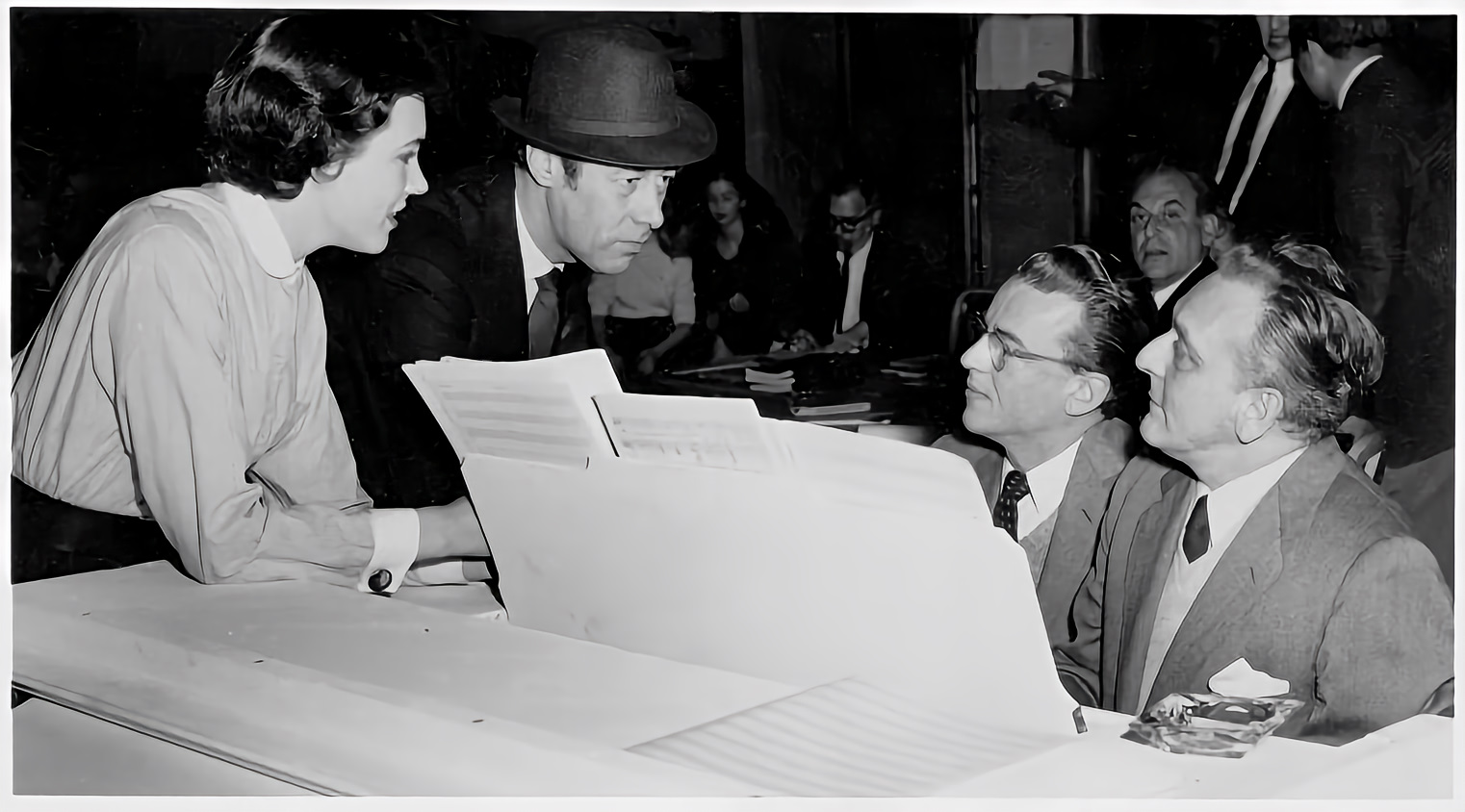
The New York production, opening on 15 March 1956 at The Mark Hellinger Theatre, had a dream cast of its own. Rex Harrison as Higgins, 22 year-old English girl Julie Andrews, who drew attention as Polly in The Boyfriend two years before, was perfect as Eliza. Stanley Holloway was Doolittle, a role which could have been written for him, and Robert Coote played Colonel Pickering. They would repeat their roles for the London production which opened at the Theatre Royal, Drury Lane on 30 April 1958. The Broadway production had a long run of 2,717 performances and was Broadway's longest running musical to date. The London production presented 2,281 performances while the Australian production, which ran from 1959 until 1964, clocked up 2,500 performances and a gross of nine million dollars!
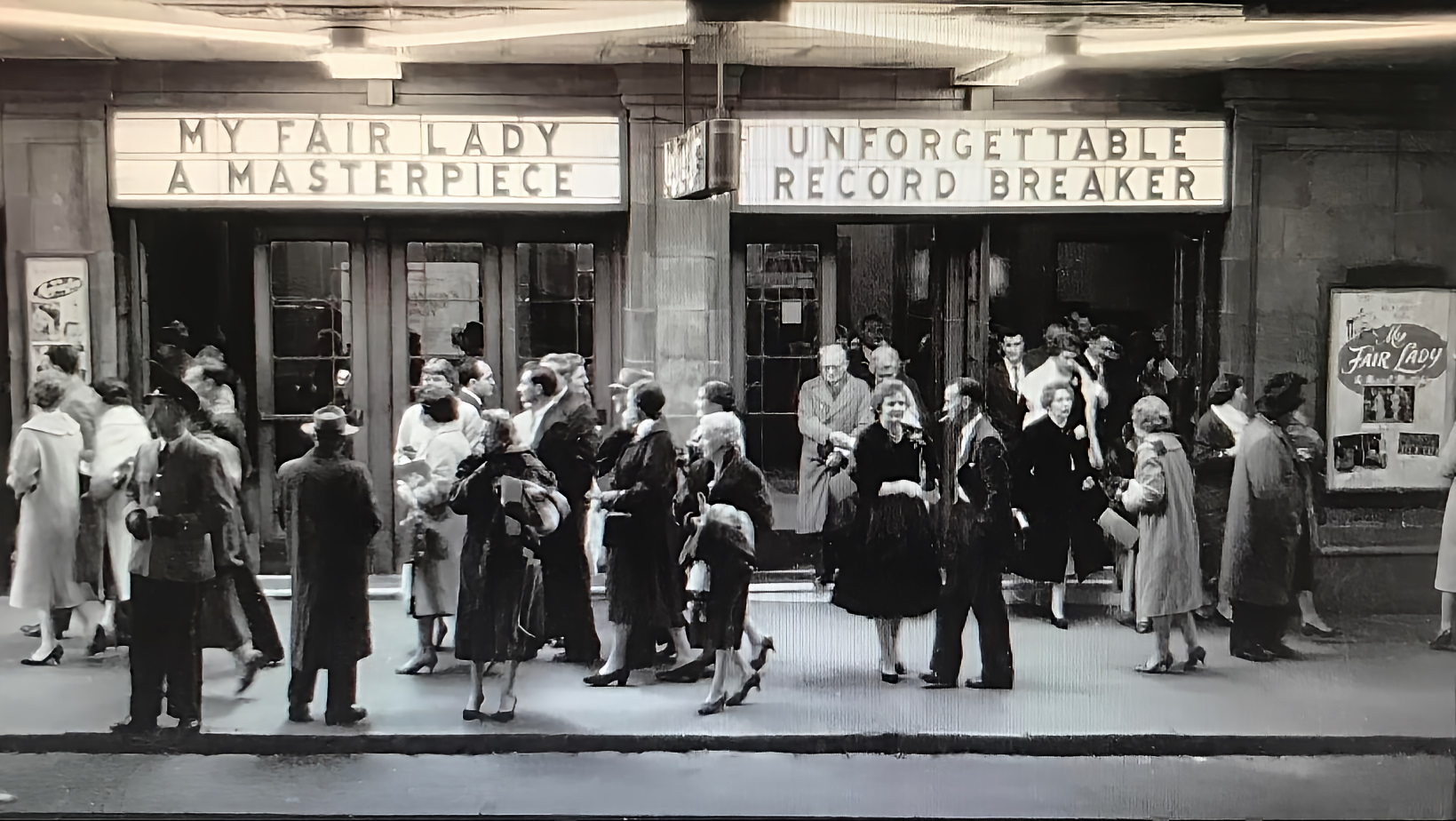 Her Majesty's Theatre, Melbourne during the record run of My Fair Lady.
Once Sir Frank Tait had bought the rights for the show, discussions began with the Americans about bringing the show out, and they were very firm that THEIR people would head the creative roles. The director was Sam Liff , known as "Biff" Liff, he had acted as Production Stage Manager on the original Broadway and London productions from their inceptions. He knew every aspect of the show inside out, having worked very closely with the original director, Moss Hart right from the start. He would also work with Alan J. Lerner again on the Broadway production of Camelot from its inception. Hanya Holm's original choreography would be reproduced by Pat Drylie who was a dancer in the Broadway production and also acted as Ballet Mistress. J.C. Williamson's choreographer Betty Pounder was their choice for the position, but the Americans were firm. No one was going to touch anything to do with the show and nothing would be altered. Miss Pounder was made assistant to Pat Drylie and credited in the programme as Ballet Mistress. Once Mr. Liff and Ms. Drylie had boarded the plane to return home, and their seatbelts were fastened securely around their waists, John McCallum made alterations in some areas of the direction and Betty Pounder did the same with the dance routines, each making improvements to the originals. When the second companies were formed, some more slight alterations were made, again for the show's betterment. Pat Drylie had a reputation within the company of never smiling. NEVER! If you didn't live up to Ms. Drylie's expectations, you were out. When once asked by a member of the company why she never smiled, she replied, "I'll smile when this is over. Right now nothing matters except knowing the routines!" Never included in any discussions by the Americans about the show, Pounder, as she was always known in theatre circles, was always on hand to help any dancer or performer who was having trouble with a step, a line, or a line in a song. In the original programme the credit for choreographer is listed as "Original Choreography and Musical Numbers staged by Hanya Holm. Adapted by Pat Drylie." When the second company was formed it was rephrased following Hanya Holm's name, "And staged in this Production by Betty Pounder." There is no mention of Pat Drylie.

Sam Liff

Gabriel Joffe & Pat Drylie
The audition process was lengthy with around one thousand dancers to choose from and nearly the same number of singers. Sam Liff, Pat Drylie, John McCallum held the auditions looking for dancers who could cope with the various styles of dancing needed for the show, singers who had the right vocals for the cockney and upper-crust characters of the show. On top of this, the members of the ensemble all had to have the right look to carry off the Cecil Beaton designs. It was one thing to have the singing and dancing abilities required, but another thing to be able to carry off the style required for the Ascot costumes.

Sir Frank Tait watches the rehearsals from the auditorium of Her Majesty's Theatre.

Betty Pounder rehearses the dancers on the stage set of Higgin's study.
The dancer's rehearsals were exhaustive, doing the "Jig" from "Get Me To The Church On Time" from 9 am until into the evening. It was like running a marathon doing it in its entirety and the dancers often went through it ten or twelve times in the morning and again in the afternoon. It was worth it though, stopping the show at each performance. The Ascot Gavotte was another thing. NO expressions or emotions were allowed. Often played in a "haughty" manner today, the original feel of the number was to show absolutely no emotion but to keep the face blank. The only time there was any break was during the line, "What a frenzied moment that was", when the dancers simply shifted their weight from one foot to the other, bringing with it gales of laughter. The women walked around the stage in exaggerated poses, particularly the dancer called "The Bend-Back Girl" who literally had to spend the entire scene leaning back as far as she could with her back parallel to the stage. While it was a featured part which always drew good laughs, it was a killer to actually perform and the girls often rotated the role to give their backs a break, so to speak! It was an honour to have been asked to be The Bend-Back Girl though, a role new-comer Nancye Hayes was given when she joined the show in the second company. During Betty Pounder's appearance as the featured guest on the television program, This Is Your Life in 1980, Bunty Turner joked, "I've actually got a bone to pick with Pounder. Night after night when people would come backstage to see me in my dressing-room, the first thing they would say to me was, 'Where did they find those sensational girls?' And it was true, the dancers stole the show!"
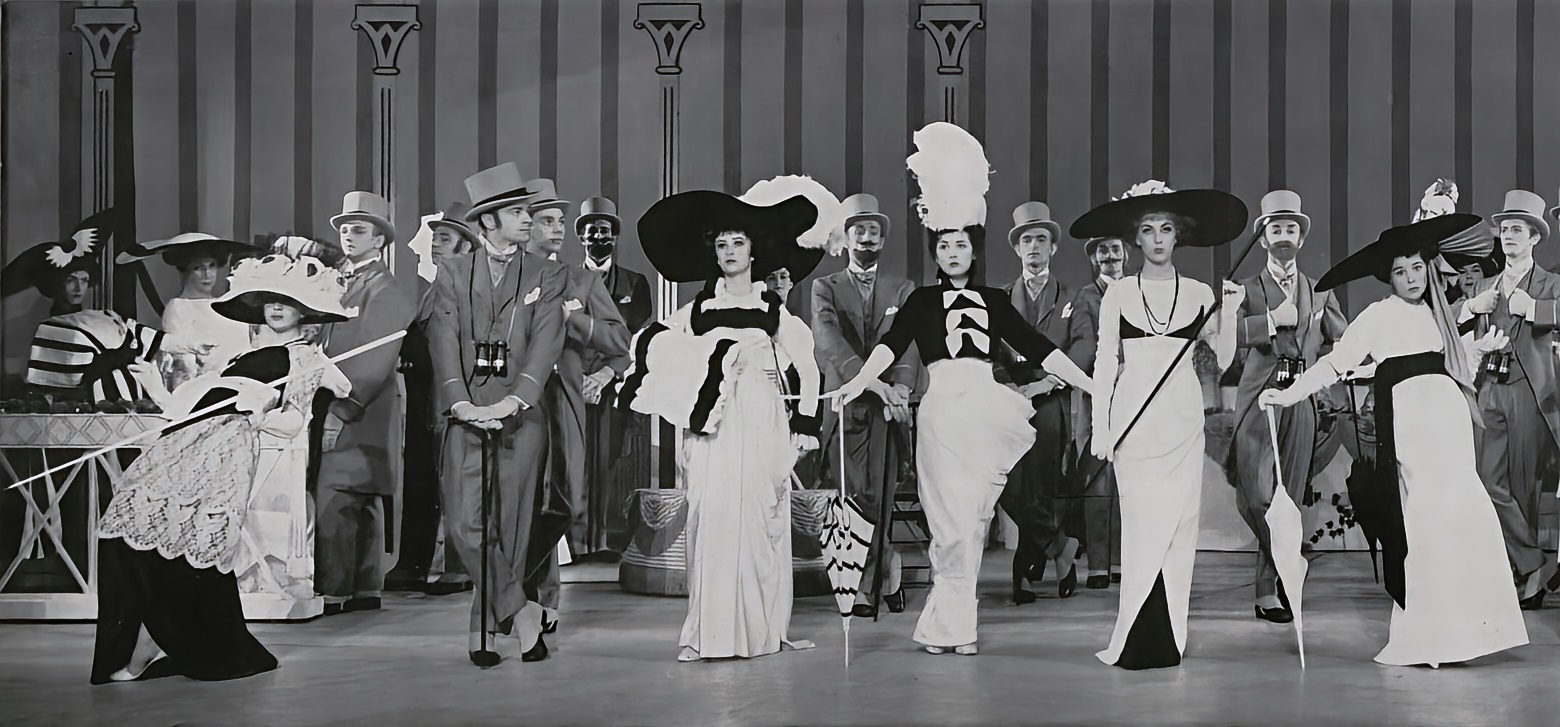 The racegoers pose for the opening of the Ascot scene with the "Bend-Back Girl" at the far left
After one and half years in Melbourne, Sydney was demanding to see the show, but Melbourne's audiences were still flocking in droves to see it and so, in an unprecedented move, the decision was made to form a second company.
The original company gave its last performance at Her Majesty's Theatre in Melbourne on 29 April 1960 and the company split in two, devastating the cast who were like close family after one and a half years together. New cast members were added to each half, one half staying in Melbourne with new additions and the second half going to Sydney to open at The Empire Theatre, which had been revamped for the incoming show, as well as being given the new name, Her Majesty's Theatre. Leads Robin Bailey, Bunty Turner, Richard Walker and Kenneth Laird went to Sydney and new leads David Oxley, Patricia Moore, John Bascomb and David Hutcheson took over in Melbourne finishing out the season which concluded on 15 October 1960. Other new cast members were Minnie Love as Mrs. Higgins, Robert McPhee was promoted from the ensemble and small roles to play Freddy, and Jessica Page was the second company's Mrs. Pearce. The Sydney opening was lavish and spectacular, although not quite to the extreme of the Melbourne opening.
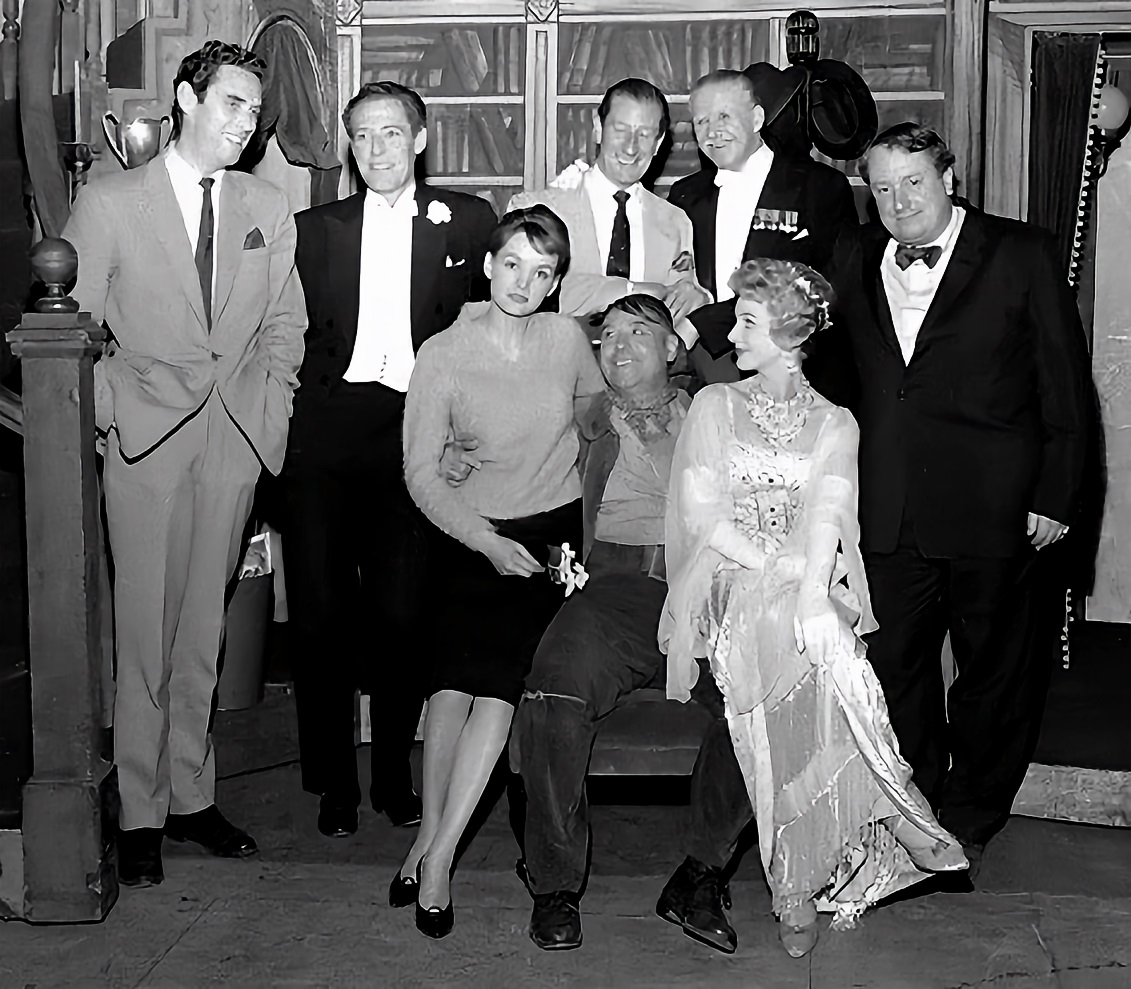 The new principals pose with their counterparts from the original cast.
The first company continued in Sydney until October of 1961 and then went on to tour Brisbane, a return season in Melbourne, Perth, Adelaide and then back to Sydney for a farewell season, concluding on May 18, 1963. Cast changes occurred during the tour when Robin Bailey left the show with Michael Denison taking over as Higgins in 1962, and Stuart Wagstaff taking over with Jane Martin as Eliza in 1963.
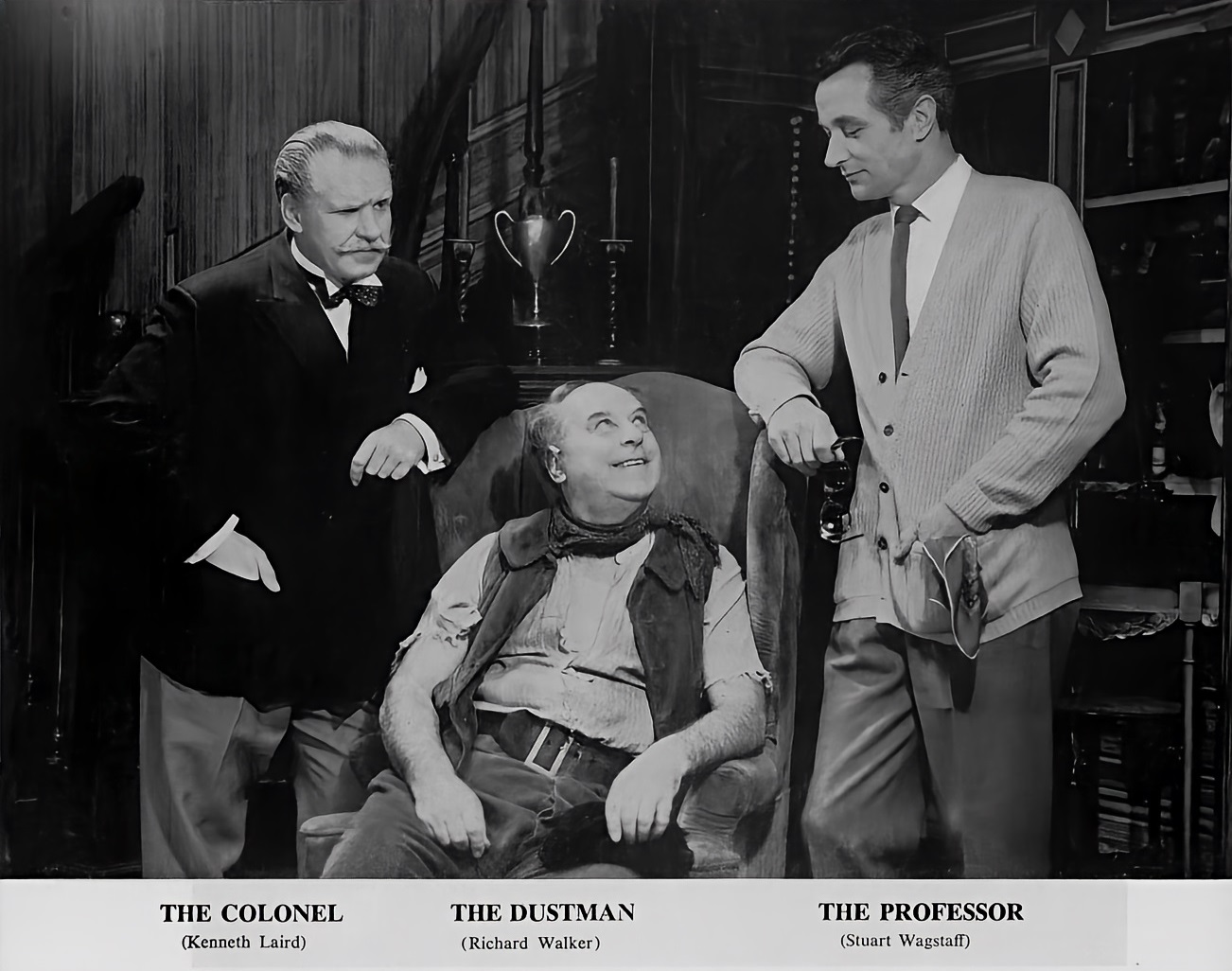
The second company would go on from Melbourne, to Adelaide and then tour through New Zealand and South Africa. For the New Zealand tour of 1962, Keith Lee took over as Higgins. A huge logistic job organising the two companies' seasons, to say nothing of the fact that a second complete set of costumes had to be made, a massive expense for the second company, as well as an entire second set of scenery, also a huge expense.
During the show's run, it had many international visitors, four Hollywood stars coming in to see the show not long into the original Melbourne run being Gregory Peck, Ava Gardner, Fred Astaire and Anthony Perkins, who were in town during the filming of the movie On The Beach. The cast and theatre management met them on the stage of Her Majesty's after the show and posed for photos. Betty Pounder recalled how thrilled she was when Fred Astaire commented on the energy and vitality of the Australian dancers and went straight to them to talk about how impressed he was with them. French movie star and cabaret performer Maurice Chevalier was another visitor. Danny Kaye came in while he was appearing at The Princess Theatre. If you were in Melbourne at the time, My Fair Lady was a must-see!

Fred Astaire and Gregory Peck meet the cast (with Betty Pounder standing to the right of Astaire)

Ava Gardiner meets the prinicipals, Bunty Turner, Robin Bailey and Kenneth Laird.
THE COSTUMES.
No better costume designer could have been selected for My Fair Lady than Cecil Beaton. The question was once asked, "Did Cecil Beaton invent the Edwardian era, or did the Edwardian era invent Cecil Beaton?" An expert in the era, his incredible memory stored the dresses he saw on the London stages as a child, and taking snatches of them here and there, he assembled them into one breathtaking gown. Mrs. Higgins arrived at Ascot in a dress similar to one he remembered his mother wearing. Eliza's ballgown drew from creations once worn by Lily Elsie and Gaby Deslys. Interesting choices were made such as Eliza's opening scene skirt which was made out of candlewick, or chenille, bedspreads. The same bedspreads were used for the female chorus member's Act 2 "Get Me To The Church On Time" skirts and this choice has been used in every successive production with the Beaton designs. An amusing fact shared by one of the Australian dancers in the original company was, during the dance section of this number, for the first month or so, there was a cloud of fine chenille wafting all over the stage from the newly cut bedspreads until they settled in!

Robin Bailey and Bunty Turner in the opening scene.

Higgins and Eliza dance at the Embassy ball.
Winning the Tony Award for his work on the production, Beaton was in his element with My Fair Lady, Edwardian to the hilt, and he had enormous fun with the Ascot number, dressing the women largely in black and white with the occasional touch of blue or red here and there, and the men in their grey suits and top hats. Beaton's choice of black and white was a nod to the mourning in 1910 for King Edward VII. Mauve and purple are colours also associated with mourning, hence Eliza's entrance in mauve, the only colour on the stage in that scene. The Embassy ball saw the ladies in various shades of sherbert chiffon and beading, the only white gown being that of Eliza who wore an Edwardian gown of shimmering bugle-beads, diamantes and rubies. The costumes for the production were made in the JCW Wardrobe workrooms behind Her Majesty's Theatre in Melbourne, the Ladies' costumes in the charge of "Henry" of J.C.W. Modes, and the Men's wardrobe was supervised by Kevin Miller. Bunty Turner was sent to London to be fitted, at GREAT expense, by Monty Berman, who had made all of Julie Andrews' costumes for the Broadway and London productions. It was in London during the costume fittings that Bunty met Miss Andrews who gave her some interesting advice. "No matter how good your Cockney accent is, it will be criticised by those who think they know better. And no matter how bad your Doolittle is, he will steal the show. It's all in the writing!" Fortunately, Richard Walker's Doolittle was faultless.
THE SCENERY
So spectacular was the scenery for My Fair Lady that its designer, Oliver Smith, wrote that watching the transition from the Embassy Promenade into the Ballroom never failed to thrill him with the columns swinging into position on the twin revolves, missing each other by inches. Smith won the Tony Award for his superb work on the musical and with the audience's appreciative reactions at each performance, it was easy to see why.
For the Australian production, JCW master scenic artist, J. Alan Kenyon, received an unexpected and unusual compliment from the Americans when they saw his work on the settings. Having only been given a series of photographic slides from the Broadway production to work from, a lot of the detailing was hard to pick up, so Kenyon had to improvise. Having been given strict instructions (and the same instructions were given to the wardrobe department), that everything must be an absolute carbon copy of the original designs, when Sam Liff saw Kenyon's finished work, he announced there were differences in the detailing. BUT... they were improvements. "I won't say anything if you don't!" Kenyon received a similar compliment by the American producer of the 1952 JCW production of South Pacific as he left the Stage Door for the last time. "And tell Kenyon his work makes the Broadway sets look positively shoddy!"
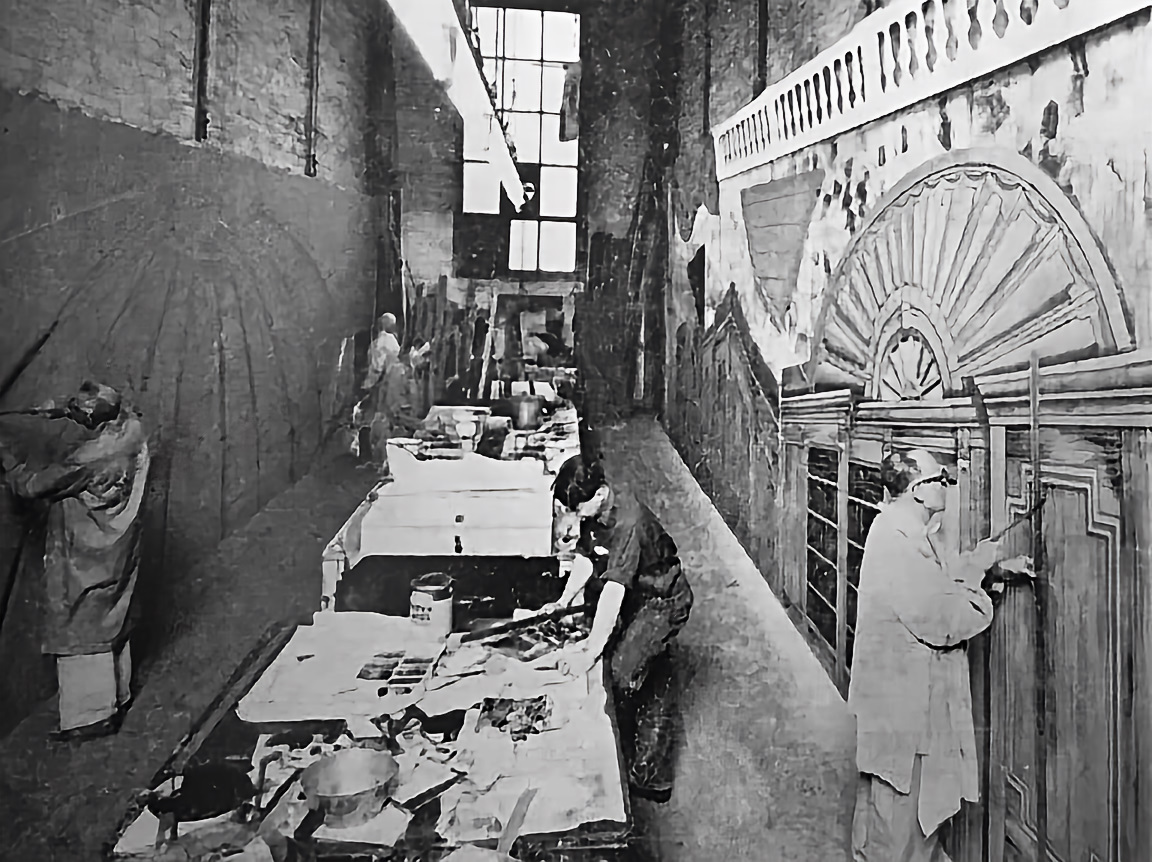 J. Alan Kenyon and assistants at work on the scenery in the paint frame at Her Majesty's Theatre, Melbourne
The finished scenery

The Show Curtain

The opening scene at Covent Garden

Higgin's Wimpole Street study

The Covent Garden Flower Market
(National Library of Australia, Canberra)
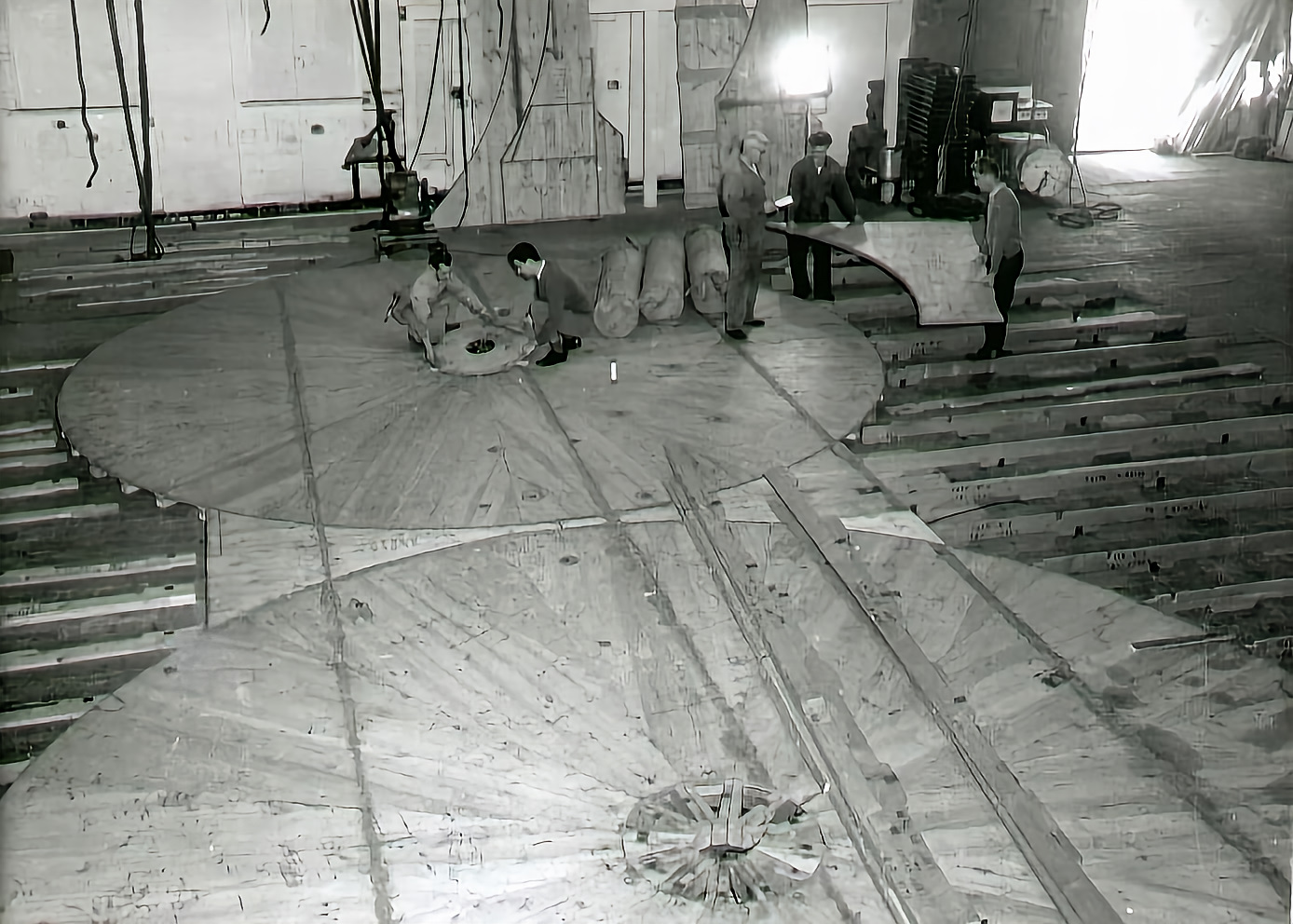 The twin stage revolves under construction.
THE 1970 REVIVAL
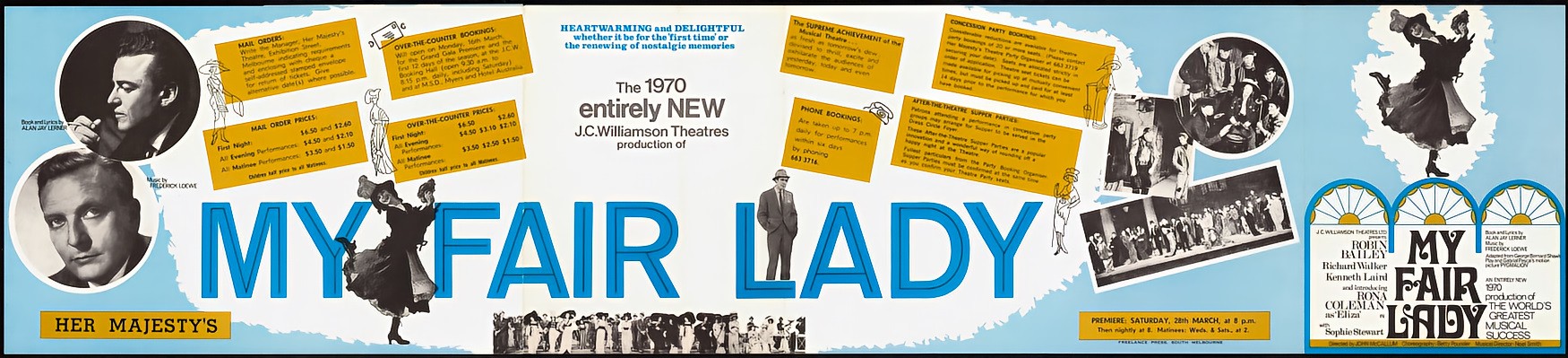
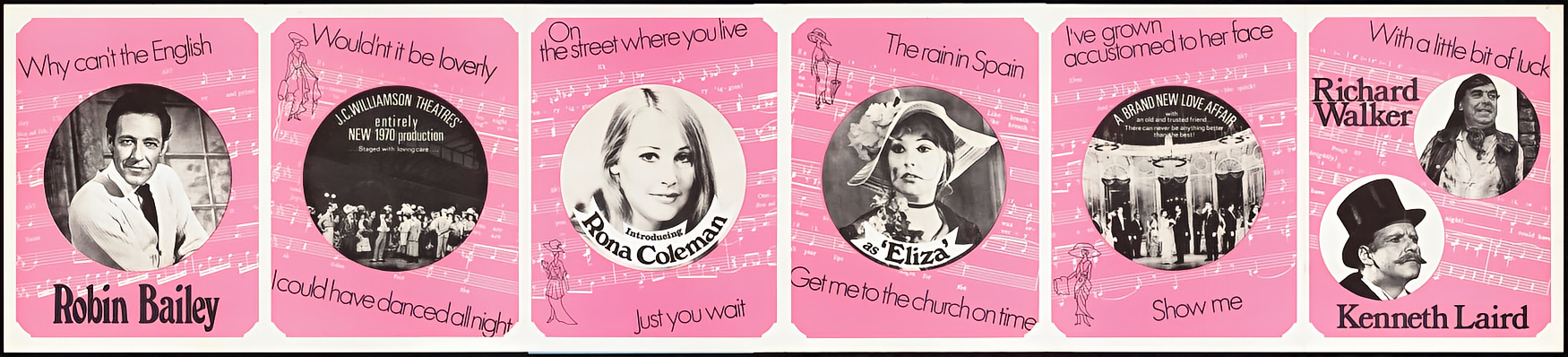
In 1970 JCW Managing Director, John McCallum, decided it was time to stage a revival. Robin Bailey came back to reprise the role of Henry Higgins, as did Richard Walker as Doolittle and Kenneth Laird as Colonel Pickering. Also back from the original company was Roger Cox who played one of Doolittle's off-siders, Jamie. Richard Walker's wife, Helen Roberts returned as Mrs. Eynsford-Hill, the role she played in 1959; JCW veteran Ralphine Sprague was back as the Queen of Transylvania and ensemble singers and JCW stalwarts Audrey Davis and Olive Kingette and Fred Paterson also came back for the revival. Geraldene Morrow once again was the Eliza understudy. Other JCW regulars Jeanne Battye played Mrs Pearce, Sophie Stewart was Mrs. Higgins, John Lidgerwood played Freddy and Tony Ingersent was Karpathy and acted as the Higgins cover. The only other role to cast was that of Eliza Doolittle. Bunty Turner had a new working life as entertainment editor and journalist for Ita Buttrose's new magazine, ITA, travelling the world interviewing movie and stage stars, and major operatic and ballet performers. Ultimately the coveted role went to young starlet, Rona Coleman, who had a strong background with NIDA, the Old Tote as well as strong television and radio experience.
The revival was directed by John McCallum, Betty Pounder got her choreography notebooks out and reproduced the 1959 routines and the Musical Director was Noel Smith. Scenic artists J. Alan Kenyon and Ross Turner got the old sets and furniture out of storage from the JCW warehouse in Richmond, retouching things where needed and Kevin Miller and his assistants made new costumes for the production, the majority being copies of the originals, although not with the same high quality of fabrics. The planned seasons were relatively short so Williamson's weren't prepared to throw the same money on the revival as was lavished on the original production. The formidable Ian Roberts was Stage Director once again.
-1-1.jpg) Ian Roberts (and assistants), calling the show from the Prompt corner.
Ian Roberts (and assistants), calling the show from the Prompt corner.
The Melbourne season ran for two months, with Adelaide and Brisbane playing for one month each. About a month before the move to Sydney, a fire broke out at Her Majesty's Theatre during The Australian Opera's 1970 season, taking with it all of the scenery and sets for their five opera season and ending any plans for a season at The Maj.
The 50th anniversary reunion of the original cast members was held at Her Majesty's Theatre in Melbourne on Monday, 9 February 2009 with over sixty of the first and second company cast members in attendance. Produced by original production dancer, Robert Foster and HMT archivist and former JCW singer Mary Murphy, the event was hosted by Stuart Wagstaff, Mary, and Bunty Turner with musical numbers performed by Reg Gorman, Shaun Murphy and a selection of Will Conyers' vocal students.
The 60th anniversary reunion was also held at Her Majesty's Theatre in Melbourne on Monday, 21 January 2019 with a much smaller number of original cast members present. Kevin Coxhead produced and hosted the event with musical numbers once again being performed by select students of Will Conyers.
Original company and second company cast members, 1959-1964, were guests at the Sydney and Melbourne opening nights of the Opera Australia-John Frost anniversary recreation production of My Fair Lady at The Sydney Opera House on 6 September 2016 and Melbourne's Regent Theatre on 16 May 2017, the lavish production using Cecil Beaton's and Oliver Smith's original costume and set designs as well as Abe Feder's lighting plots, but with enhancements to suit today's audiences and to lift the general look of the show into the 21st Century. Dame Julie Andrews directed the show.
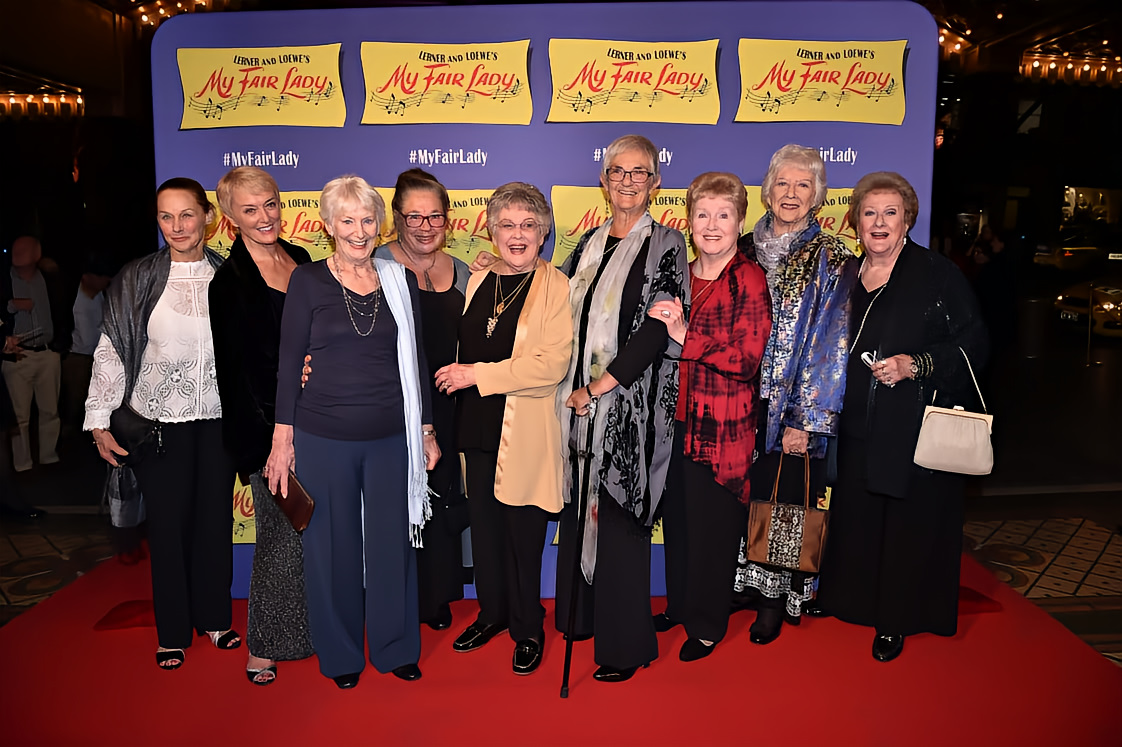 Original Australian cast members reunited for the 60th anniversary production.
On "Eliza Doolittle Day", the twentieth of May, 2017, one hundred guests attended a special Gala at Melbourne's Regent Theatre, guests included cast members from the original 1959-1964 companies, the JCW 1970 revival and the Victorian State Opera revival of 1988. Opera Australia-John Frost cast members Robin Nevan (Mrs. Higgins), Reg Livermore (Alfred P. Doolittle) and Tony Lleywellyn-Jones (Colonel Pickering), were special guest speakers.
NOTABLE AUSTRALIAN PRODUCTIONS
1959-1964 Original Australian Production
Robin Bailey, later David Oxley, Michael Denison, Keith Lee and Stuart Wagstaff
Bunty Turner, later Patricia Moore and Jane Martin, Richard Walker, later John Baskcomb, Kenneth Laird, later David Hutcheson,
David Grey, later Robert McPhee. Ailsa Grahame, later Minnie Love, Lily Moore later Jessica Page
1970 Revival
Melbourne, Adelaide and Brisbane, Sydney cancelled due to fire at Her Majesty's Theatre
Robin Bailey, Rona Coleman, Richard Walker, Kenneth Laird, Sophie Stewart, John Lidgerwood, Jeanne Battye, Helen Roberts, Robert Healey, Roger Cox, Ralphine Sprague.
Directed by John McCallum, Choreographed by Betty Pounder, Musical Direction by Noel Smith and Brian Buggy. Scenery by Oliver Smith, Costumes by Cecil Beaton.
1980 Revival
L.W. Productions. Stuart Wagstaff, Peta Toppano, Rick Burchall, Barry Quin, Bill Kerr, Aileen Britton.
Directed by Stanley Walsh, Choreographed by Joe Latona, Designed by Tom Lingwood.
1988
Victorian State Opera. Lewis Fiander, Helen Buday, Warren Mitchell, Noel Ferrier, Simon Gallaher, June Bronhill, Madge Ryan.
Directed by Rodney Fisher, Choreographed by Betty Pounder, Musical Direction by Andrew Greene, Scenery by Anne Fraser, Costumes by Jan Hurley
1993
Victorian State Opera. Anthony Warlow, Suzanne Johnston, Noel Ferrier, David Ravenswood, Timothy Rogers, Margaret Haggart, Patricia Vivien.
Directed by Rodney Fisher, Choreography by Nancye Hayes, Musical Direction by Brian Stacy, Scenery by Anne Fraser, Costumes by Jan Hurley.
2005
ACT Inc. Alan Fletcher, Laura Fitzpatrick, Jon English, Marty Fields, Roger Oakley, Babs McMillan, Chris Durling.
Directed by Darien Stricklen, Choreographed by Joanne Adderley, Scenery by Ross Turner.
2008
Opera Australia. Reg Livermore, Taryn Fiebig, Robert Grubb, John Wood.
Directed by Stuart Maunder, Choreographed by Elizabeth Hill, Designed by Roger Kirk.
2016
Opera Australia and John Frost. Alex Jennings, later Charles Edwards, Anna O'Byrne, Reg Livermore, Robyn Nevin, Tony Llewellyn-Jones,
Mark Vincent, Deidre Rubenstein. Directed by Julie Andrews. Choreographed by Christopher Cattelli.
Costumes by Cecil Beaton, recreated by John David Ridge. Scenery by Oliver Smith, recreated by Rosaria Sinisi.
This was the 60th anniversary production of the show in an enhanced recreation of the original production.
2026
Opera Australia and John Frost are reviving the production this year to celebrate the 70th anniversary of the original production.
Reg Livermore, Tony Llewellyn-Jones, Robin Nevin, Anne Wood, Freddy Hellier.
Directed by Karen Mortimer-Johnston, based on Julie Andrews' direction,
BROADWAY and LONDON REVIVALS
1976 Broadway
1979 West End
1981 Broadway
1993 Broadway
2001 West End
2018 Broadway