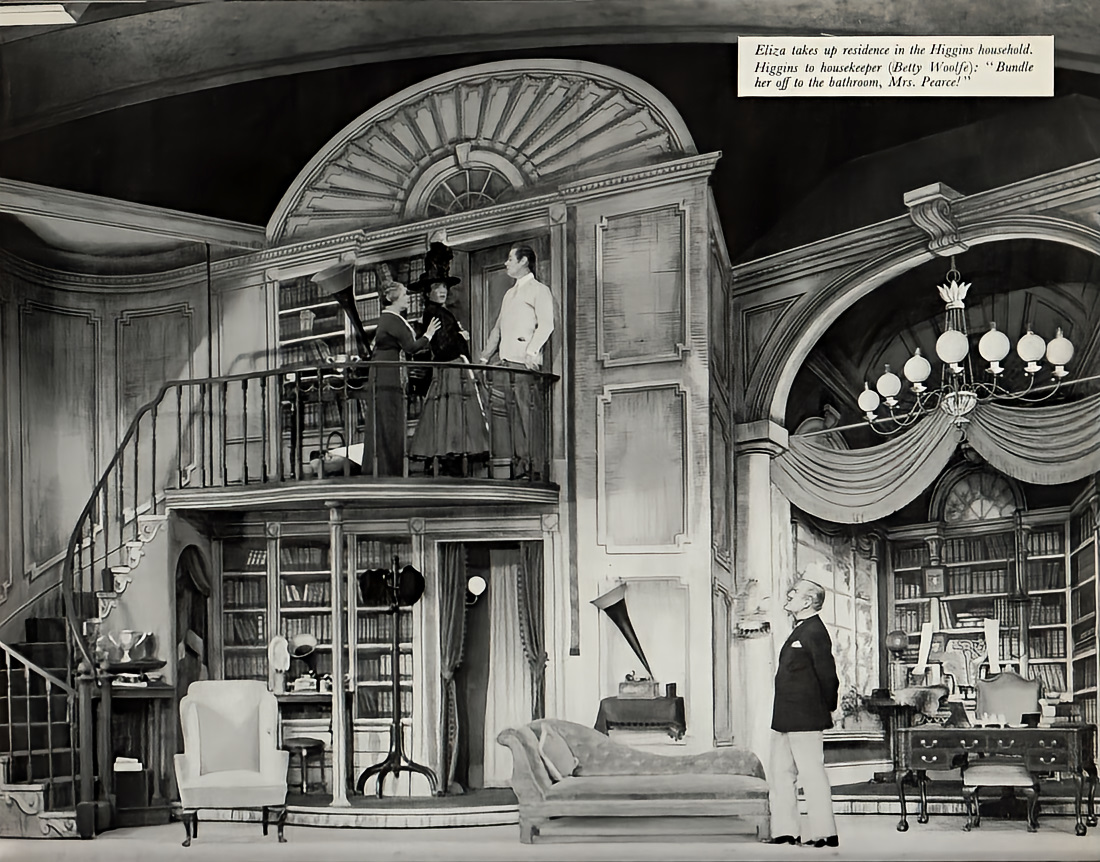
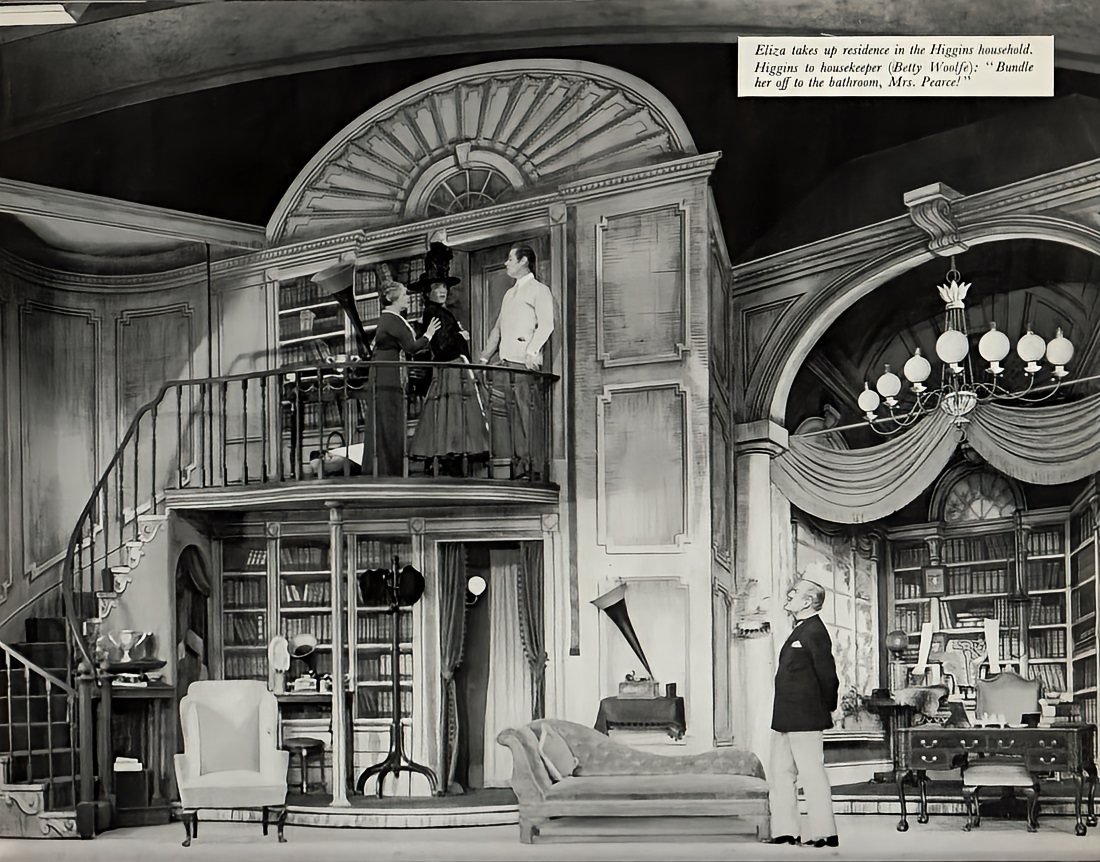
 Higgin's study - London production (Elisabeth Kumm collection)
My Fair Lady opened at The Theatre Royal, Drury Lane on April 30, 1959, playing for 2,281 performances, running for over six years, beaten only by the British musical, Salad Days, which clocked up 2,283 performances, just two more than Fair Lady.
Rex Harrison repeated his performance as Henry Higgins, as did Julie Andrews as Eliza, Stanley Holloway as Alfred P. Doolittle and Robert Coote as Colonel Pickering. Zena Dare played the role of Mrs. Higgins and she was the only principal cast member to stay with the production for its entire five and half year run, followed by a season on tour. It would be her final stage appearance. Mrs Pearce was played by Betty Woolfe.
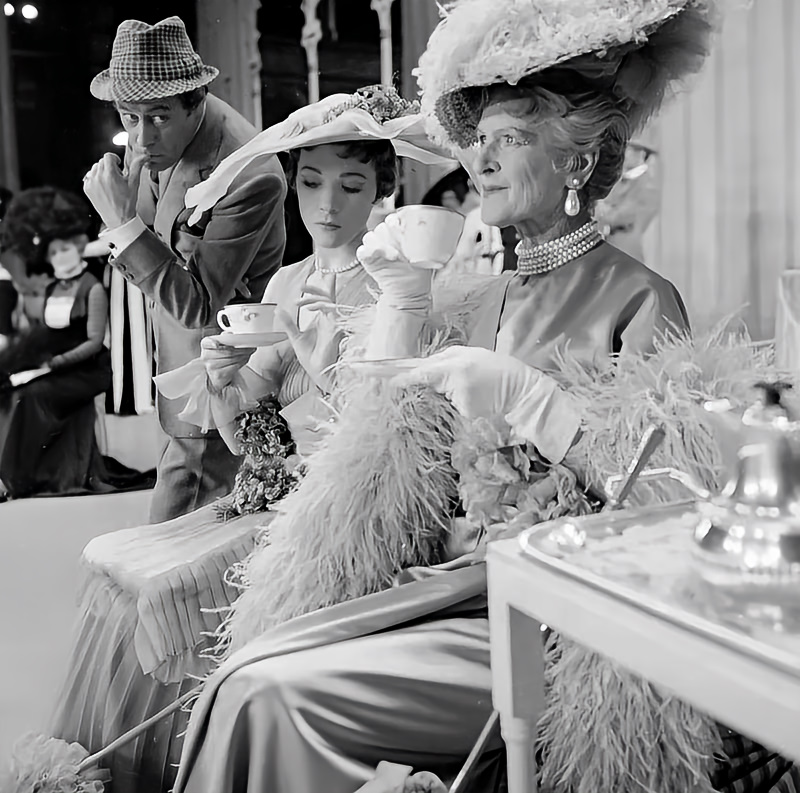 Rex Harrison and Julie Andrews with Zena Dare. A veteran of Edwardian British musical comedies, Dare commenced her stage career in pantomime in 1899 at the age of 12 years old.
Australia would be nicely represented in the London cast with Robert Chisholm playing the roles of "A Bystander", "An Ambassador" and Jamie, a friend of Doolittle. He had begun his professional career with J. C. Williamson's in 1921 appearing alongside Gladys Moncrieff in The Maid of the Mountains, Katinka, and The Merry Widow and became quite a matinee idol of his era. He left Australia and performed extensively on Broadway, including with Carol Channing in Gentlemen Prefer Blondes, and also in the West End, travelling back to Australia to perform between engagements. My Fair Lady would be his final stage appearance, leaving the show and returning home to Melbourne in March of 1960 and dying in South Yarra in November of that year. He can be heard on the original London cast recording with Stanley Holloway in the songs "With A Little Bit of Luck" and "Get Me to the Church On Time".

Eliza and her cockney friends at Covent Garden market, with Robert Chisholm as Jamie seated on the right.
(Elisabeth Kumm collection)
Australia was also represented in the cast by Melbourne born lyric tenor, Leonard Weir who had been a Sun Aria finalist in 1952. Having arrived in London a couple of years before My Fair Lady opened, he got word that the producers were looking for a singer, the show opening in just ten days. Assuming it would be a small part, he went along to the audition where he found himself singing for Frederick Loewe, the show's composer, Moss Hart, the director, and the London producers. Asked to sing "On the Street Where You Live", he was surprised to learn the audition was for the role of Freddy. So impressed were they, they gave him the role on the spot. He had five days to learn the part. Leonard Weir is heard singing Freddy's solo and "Show Me" with Julie Andrews on the original London cast recording.

A publicity photo of Leonard Weir singing "On the Street Where You Live".

Leonard Weir as Freddy Eynsford-Hill in the Ascot scene
Tasmanian Max Oldaker, the third principal player in the production, played Zoltan Karpathy and also had the job of understuding Rex Harrison in the role of Higgins, going on for him a number of times. A former matinee idol and veteran of the Australian stage, Max was determined to play Higgins in the Australian production and badgered Sir Frank Tait to give him the role. Sir Frank knew it was going to be around two years after the London opening before the show would arrive in Australia and could not possibly promise anything, particularly seeing the American producers would have a heavy say in the casting of the main leads. Sir Frank promised to arrange a meeting with the show's big wigs though and, indeed, this would take place in London.

Max Oldaker (publicity portrait by Anthony Buckley, London 1958)
(Elisabeth Kumm collection)

Julie Andrews poses with Max in his dressing room on the evening he played Higgins - July 1958
(Elisabeth Kumm collection)
Max auditioned for Moss Hart, Alan J. Lerner and Herman Levin and Hanya Holm, reading for the role of Higgins. Asked to stop, he was asked to read for Karpathy. Success. He would play Karpathy and also understudy Rex Harrison. Max felt this was the absolute starting point for him to play Higgins for the Australian-New Zealand tour. When Rex Harrison became ill and Max went on, the reaction from the cast, the audience and management was overwhelming. There were wires of congratulations from the Prime Minister of Australia, the Premier of New South Wales, Sir Frank and Lady Tait and from Rex Harrison himself. There was also one from the D'Oyly Carte Opera Company with whom he had appeared some twenty-five years earlier. Talk got around that Max would play Higgins in Australia, although the London producers were hoping he would stay with the London company to eventually take over the role when Rex Harrison's contract ran out. A few weeks after his success as Higgins, he came off stage at the end of Act One, after playing Karpathy, to find John McCallum, then Assistant Manager of J.C. Williamson's, waiting for him in the wings. He wanted to tell Max personally, that the role of Higgins had been given to English actor, Robin Bailey. It seemed Bailey had auditioned eighteen months earlier for the Americans in New York, when Rex Harrison was due to leave the Broadway production, and they wanted him to take over. Sadly he was unable to take up that offer due to other commitments, but was now free for the extensive Australian production. Max was shattered as was John McCallum, but... the Americans had absolute call over the casting and nothing could be done. When it came time for Rex Harrison to ultimately leave the London production, the role of Higgins was given to Alec Clunes, and Max continued to play Karpathy and cover Higgins. Max felt everything that had been so right about Harrison's Higgins was now gone. The relationship they had as Higgins and Karpathy was now empty and Max was often left on the stage getting little response from the audience due to the flatness of Clunes' performance.

Alec Clunes as Higgins (photo by Cecil Beaton)
(Elisabeth Kumm collection)

Alec Clunes as Higgins, Tonie Lee as Eliza & Zena Dare as Mrs. Higgins at Ascot
(Elisabeth Kumm collection)
Due to a family crisis back home in Tasmania, Max would leave the show four months after Harrison's departure and Robin Bailey would be Australia's Higgins. Ironically, while the Australian production of My Fair Lady continued its record-breaking run at Her Majesty's Theatre, Melbourne with the second company of principals in May 1960, Max was across the street appearing in the Philip Street Revue at the Comedy Theatre.
The fourth member of the London company of My Fair Lady to be represented by Australia was 18 year old Adelaide dancer, Leonie Leahy. Leonie began her professional career with the South Australian Ballet in 1955 before going to London, and on her return would be a foundation member of The Australian Ballet in 1962. She was a key figure with the company during that period, dancing lead roles in Les Rendezvous, Melbourne Cup, Jazz Spectrum, The Display and many more. Leonie would also dance internationally with the Norwegian Ballet Company, the Canadian National Ballet and the famous American Ballet Theatre.
Dancing through the '60s and into the '70s, she would become a choreographer and was also a lecturer in classical dance.
As with the Broadway opening, and the Melbourne opening as well for that matter, the My Fair Lady frenzy in London was incredible. Sessions selling out as quickly as they became available, lines around the block to the theatre box-office, shops and restaurants cashing in on the themes of the show to bring in more business, everyone desperate to get tickets and anything related to the production.
THE MOVIE
The movie rights for the show were bought by Warner Brothers in 1960 for a record $5.5 million, plus a percentage of the gross. Warners wanted big stars to assure the movie's success. Cary Grant was their first thought for Higgins, then Rock Hudson but they ultimately decided on Rex Harrison. Cary Grant told Jack Warner, "Only a fool would try and follow Rex Harrison!" James Cagney turned down the role of Doolittle and it went to Stanley Holloway, also repeating his stage role.
The role of Eliza was another thing. As big a success as Julie Andrews was in the stage production on Broadway and the West End, at that point she was not a Hollywood star, having not yet made Mary Poppins or The Sound of Music. Instead the role went to the very popular Audrey Hepburn, her singing voice dubbed by Marni Nixon. Bill Shirley would sing for Jeremy Brett in the role of Freddy.

Rex Harrison, Audrey Hepburn & Wilfred Hyde-White (IMdB)

Audrey Hepburn, Gladys Cooper & Rex Harrison (IMdB)
Finishing off the principal roles was Wilfred Hyde-White as Colonel Pickering, Gladys Copper as Mrs. Higgins, Mona Washbourne as Mrs. Pearce, Theodore Bikel as Zoltan Karpathy and Isobel Elsom as Mrs. Eynsford-Hill.
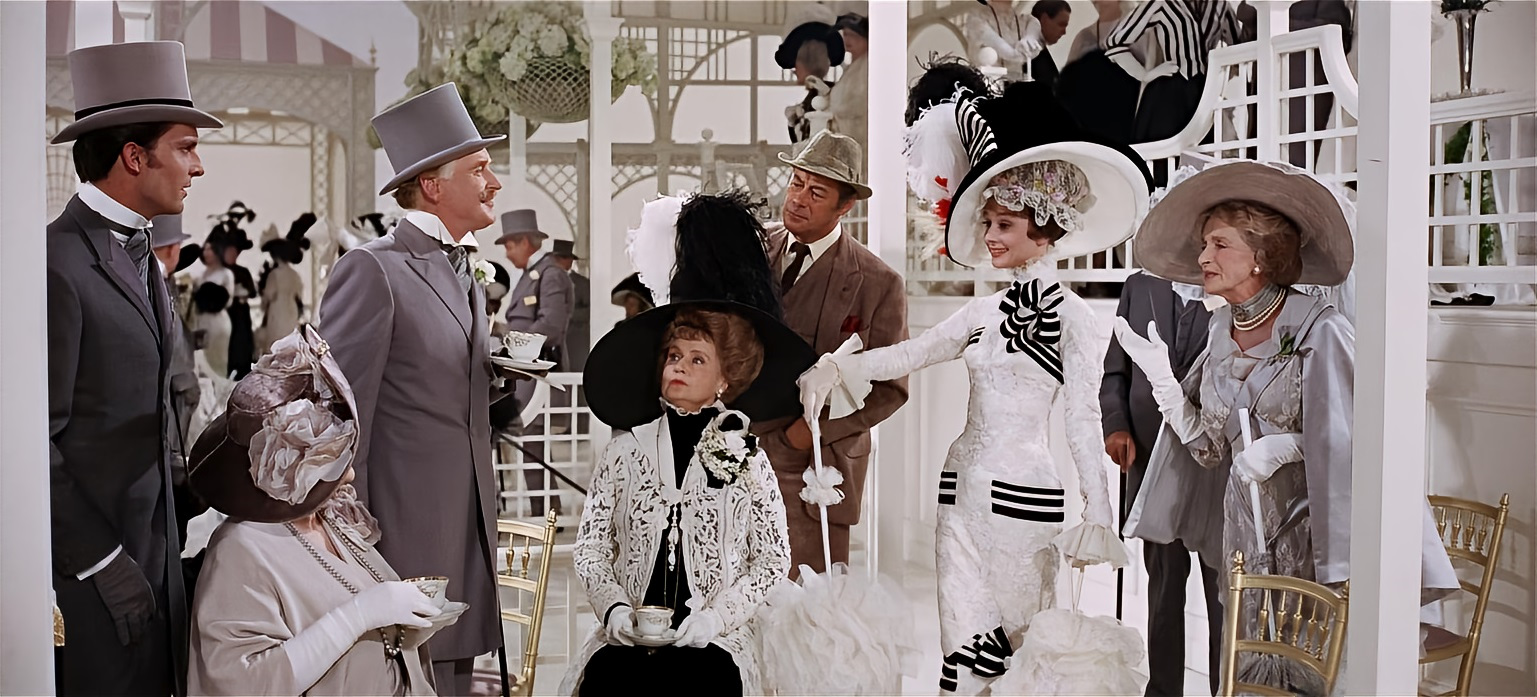 Jeremy Brett, (uncredited seated lady & standing gent), Moyna MacGill, Rex Harrison, Audrey Hepburn and Gladys Cooper at Ascot (IMdB)
Cecil Beaton was in charge of the look of the movie, covering the costume designs and settings, with Art Direction shared by Gene Allen although Allen was chiefly responsible for the set designs. Once again Beaton outdid himself for his costume designs, the Opera House cloaks, black and white Ascot creations and lavish Embassy Ball gowns winning him praise and the Oscar for Best Costumes. He also won an Oscar with Gene Allen for Art Direction, George James Hopkins winning for Set Decoration.
The movie won Academy Awards for Best Picture, George Cukor for Best Director, Rex Harrison for Best Actor, Harry Stradling for Cinematography, Andre Previn for Best Score Adaptation as did George R. Groves for Best Sound.
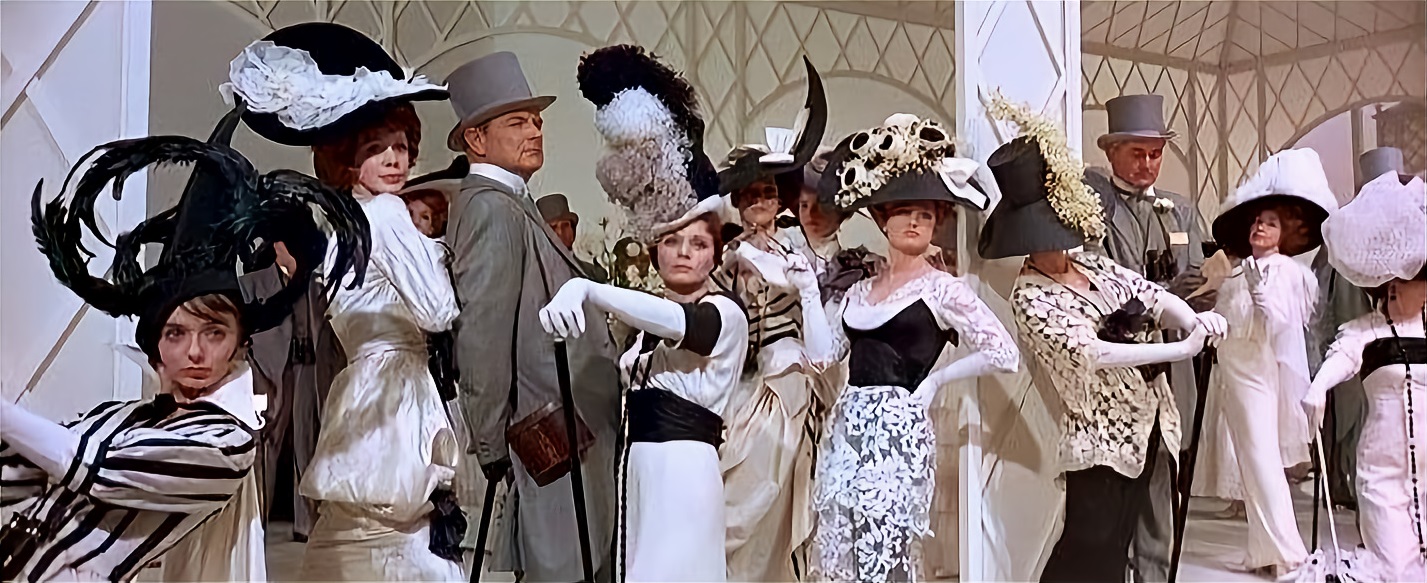 Racegoers at Ascot (IMdB)
One of the problems Cecil Beaton encountered was with the Hollywood casting agencies and the extras for the Ascot, Embassy Ball and Opera House scenes. After calls went out to the agencies and extras were sent in for their wardrobe fittings, Beaton was horrified by the girls who were sent along. Once they were put into the superb Ascot gowns, ballgowns and opera cloaks for the opening scene, the costumes looked terrible. They were all sent back and new girls requested. To his horror some of the same girls reappeared along with others who also gave nothing to the costumes. Even his, and his assistant's, favourite costumes look dull on the girls. After a third lot of unsuccessful applicants came in and were rejected, he decided to take matters into his own hands and hired former models and dancers who knew how to stand and pose in his creations, who knew how to hold their bodies and who had the right faces for the scenes they were to appear in. Success at last!
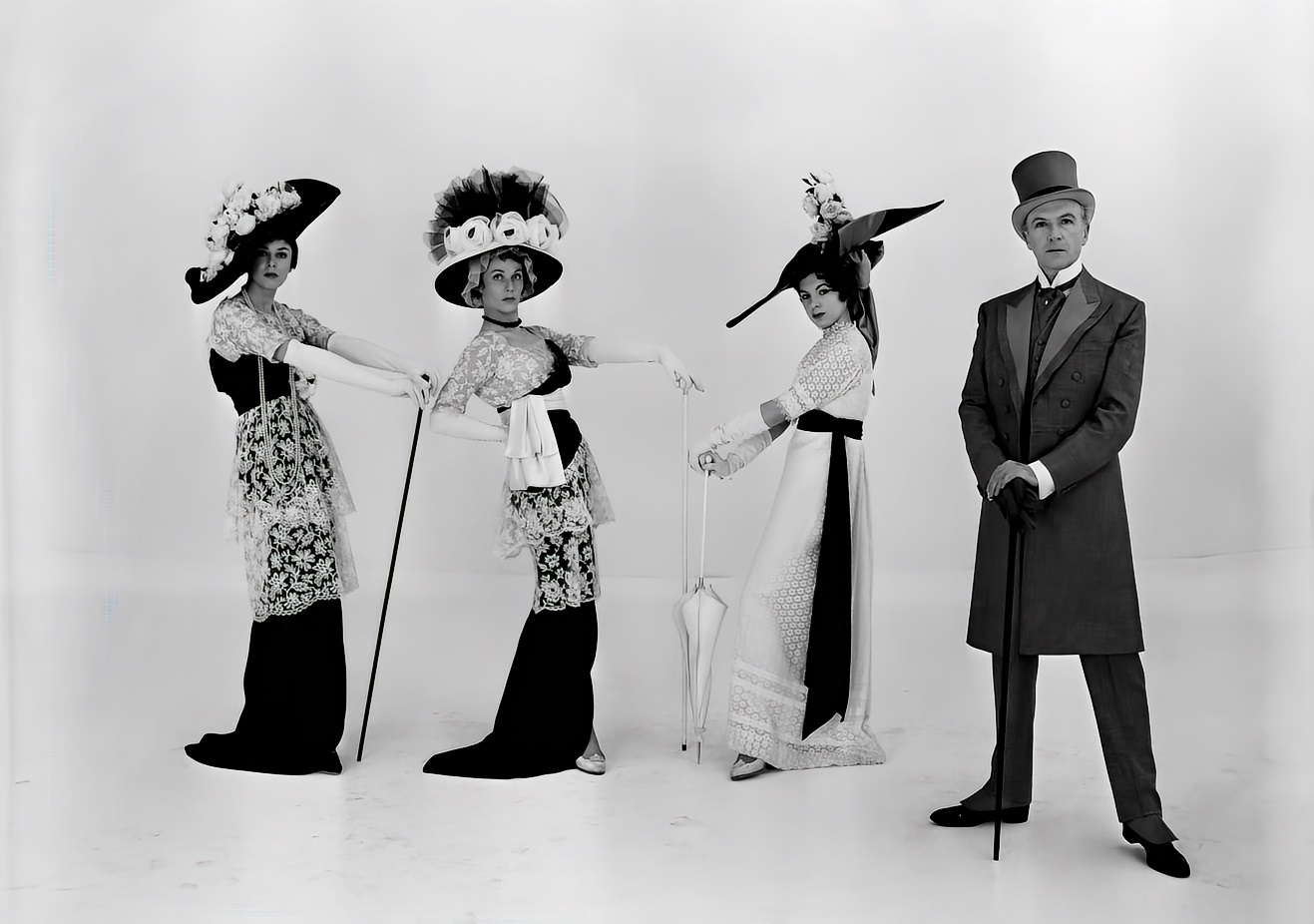
Models pose in Cecil Beaton's Ascot costumes, while Cecil himself is seen suitably attired on the right.
.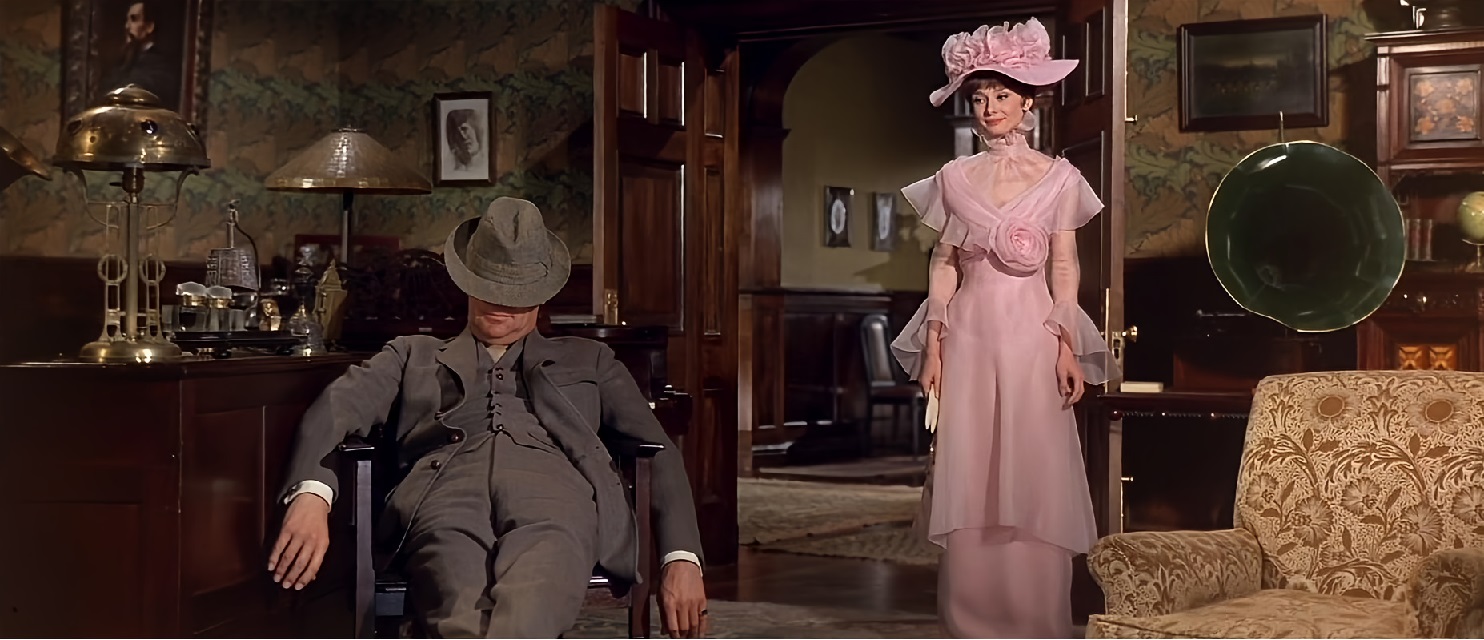 Eliza returns to Wimpole Street and Higgins (IMdB)

Academy Award-winning director George Cukor on the set of My Fair Lady (IMdB)

Movie poster (IMdB)