Henry Wood
-
Horace Stevens (Part 1)
.jpg) In the first of a series of articles DAVID HIBBARD presents an overview of the life and times of the Australian bass-baritone.
In the first of a series of articles DAVID HIBBARD presents an overview of the life and times of the Australian bass-baritone.Horace Stevens: A brief history of his career and repertoire
Introduction
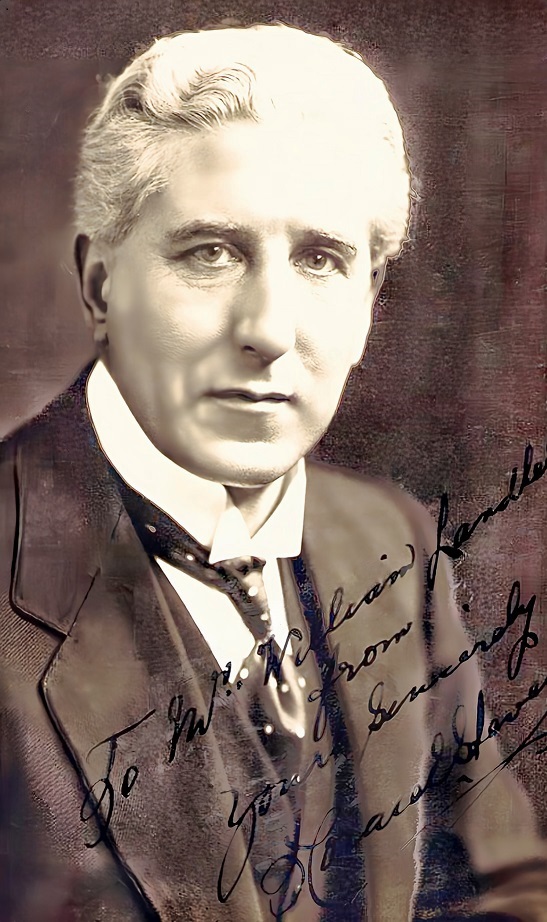
It is of no surprise that Australia has produced a plethora of excellent opera singers in the brief time Europeans have lived here. Dame Nellie Melba, though not our first opera star, is certainly one of the best remembered. She has gone down in public consciousness in part for her exceptional voice and in part for a steely desire for self-publicity. Currently there are at least five biographies of Melba on the market, including her autobiography Memories and Melodies. Opera historian Roger Neill has produced his excellent book on the students of Mathilde Marchesi, which includes not only Melba, but Australians Ada Crossley, Fanny and Martina Simonsen, and their sister Frances Alda.
Neill has also written an essay on the mysterious Australian dramatic soprano, Margherita Grandi, which places the histories well and truly into the post-world war two era. Opera Australia historian and archivist Brian Castles-Onion AM has produced a series of CDs displaying the talent of Sutherland’s contemporaries, which includes interviews he was able to undertake before some of these legends were lost to us forever.
The histories have been predominantly directed at our female stars. The glamorous Marjorie Lawrence had her autobiography Interrupted Melody turned into a Hollywood movie, and a further biography, Wotan’s Daughter has been produced following a renewed interest in her re-released live recordings. Another Brünnhilde, Florence Austral was celebrated in an autobiography by James Moffat, accompanied by a two CD set released by Larrikin Records, but what of our male singers? There have been several world class talents, and particularly in the inter-war period Australian exported a trio of exceptional baritones; Harold Williams, John Brownlee and Horace Stevens. Brownlee is remembered in America because of his time at the Met, and as director of the Manhattan School of Music. In addition, he is the subject of a biography A memoire of Don Juan, and features on the justifiably famous Fritz Busch recordings of Mozart Operas from Glyndebourne in the thirties. Harold Williams is less well remembered, although the recent re-release of the first ever complete recording of Mendelssohn’s Elijah from 1930 has brought renewed interest in his career.
Horace Stevens, on the other hand, remains an enigma. He was of an earlier generation to his aforesaid baritone colleagues, born in the same decade as singers of the golden age like Caruso, van Rooy and Tetrazzini. He arrived on the British music scene in 1919 as a dramatic baritone with his voice fully matured and nurtured by the sophisticated Melbourne musical scene of the Edwardian era. His very first performance as Elijah created such a stir, he was hailed as the greatest exponent of the role since Sir Charles Santley (an opinion echoed by Santley himself), and later endorsed by no less a personage than Sir Edward Elgar who described him as the greatest Elijah, “not excepting Santley”. His operatic debut as Wotan at Covent Garden at the age of 47 resulted in adulations from Melba, something so unusual, it was remarked upon in the newspapers of the time.

Sir Edward Elgar

Sir Charles Santley
This “out of time” quality alone is worth further investigation. By the time Stevens was creating such a stir, his operatic contemporaries had either died or retired. The interesting point to make here is that often one’s introduction to the singers of the “golden age” is an acoustic recording where the singer sounds like they’re a mile away, calling through the scratches and hiss. With Stevens we can hear what a robust sound these singers must have made, with his later electrical recordings.
The other important point I would like to make about Stevens is his pedagogic pedigree. While the majority of singers at this point in history went to Europe for their singing lessons, Stevens was a home-grown product. As a child he was taught by Mr. Charles Truelove, the chorus master of All Saints Church, St Kilda. As an adult, he seems to have been taught solely by Bessie Jukes, a close friend of his mother’s, and to whom he credited his technique quite late in life. The longevity of Stevens voice, and it sounds just as impressive in recordings made before he left Britain in 1937, also points to the amazing musical scene in Melbourne in the Edwardian era. Though he had sung no opera by the time he arrived in Britain, his knowledge of concert repertoire was astounding. He maintained a life-long love of choral works, many of which we may never hear again, due to the financial resources and sheer numbers required to stage them.
This brings me to my third and final point. We know so much more of singers in the Victorian and post-World War Two eras, than we do of the Twenties. After the First World War Europe was in a parlous financial state, and understandably the health of the Arts was not at the top priority for governments. Without the Aristocracy to fund opera and concerts, a group of concerned musicians set about creating Government funding of the Arts. This passed without a murmur in Europe, but Britain was less inclined. In 1922 the British Broadcasting Corporation (BBC) was created and, despite a rocky beginning, was able to save institutions like the Proms. Opera in Britain was not as smooth: as then, like today, its social desirability attracted too many cooks, but by 1931 Covent Garden was funded by the British Government. Against this unstable background, it is amazing that Stevens made the extraordinary impact that he did. When he returned to Australia with the Fuller Opera Company in 1934, it was expected the newly formed Australian Broadcasting Commission (ABC) would assist with the running of the company, and Australia would have a National Opera. Against the background of the Great Depression, this proved not to be the case, although Stevens continued to lobby for a national company, and was able to assist Gertrude Johnson in her efforts to create the National Theatre in the forties.

Stanley Parker caricature of Stevens as 'Wotan'
Table Talk (Melb.), Thursday, 8 November 1934, p.22

John Frith caricature of Stevens as 'Kurvenal'
The Bulletin, 6 February 1935, p.18
During the research and writing of this thesis, the writer has pondered the question “why is the Australian public so much more interested in our female opera singers, than our males”? At one stage I conjectured that it may have been a form of sexism. I suspect the true answer, though, lies in several interviews Stevens gave in the thirties where the interviewers felt compelled to point out that men in the arts weren’t “sissies”. There is something of this attitude even today. The male singers of this era we return to as a nation are Peter Dawson, who, one might argue, never had the size of voice to sing the great orchestral works, and Malcolm McEachern, who put aside his career as Hagen to become Mr. Jetsam in a popular music hall duet. Stevens remained a true artist. A friend of Ralph Vaughan Williams and Sir Edward Elgar, he is truly an Australian legend.
Preliminary considerations
Horace Stevens is an important singer for several reasons. He spans three very distinct eras in classical singing, providing a link between those scratchy acoustic recordings of the early part of the twentieth century, to his connection with a generation of post Second World War vocalists who recorded onto magnetic tape, and in stereo.
Secondly the study of his repertoire provides a window into the lost world of the great tradition of Victorian choral music, with its massive groups and extraordinary compositions, sometimes of a gargantuan size, both in physical resources required for their staging and in the physical stamina required for their length. The texts of these works comprise an eclectic group of subjects taken from the Bible, religious and secular poetry and historical subjects.
Finally, Stevens was a part of a largely forgotten group of Australian musicians who travelled to Britain, Europe and both North and South America after the First World War with remarkable success. Considering the paucity of operatic performance in Australia, their success is nothing short of miraculous. Many of these artists, Stevens included, were involved in the unsuccessful attempt by Sir Benjamin Fuller to start a full-time opera company in Australia in 1934. After his retirement from professional singing, Stevens indeed pursued a long-held desire by assisting his colleague Gertrude Johnson in the formation of an opera school to prepare a generation of young singers for their turn as Australia’s operatic ambassadors to Europe.
Stevens was born in 1876. Fifteen years younger than Melba, he was three years younger than Caruso and Chaliapin and the same age as DeLuca, the great baritone. While these singers are remembered as the golden generation that performed from 1900-1920, during this period Stevens was a successful dentist and a popular recitalist in Melbourne. Not that he was estranged from the performances of international singers. Australia, and particularly Melbourne, was visited by some of the greatest vocalists in the world, due in no small part to the influence of Melba.
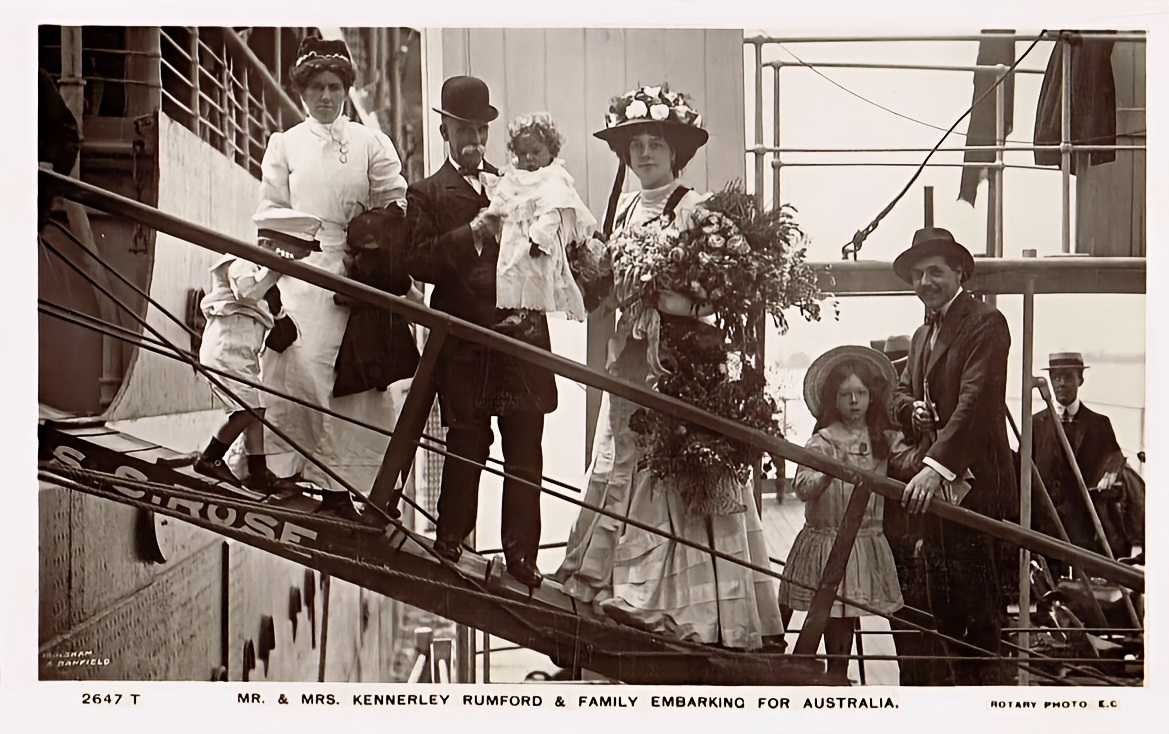 Clara Butt, Kennerly Rumford and family embark for their 1907- 08 tour of Australia and New Zealand for J & N Tait
Because of the era in which he was born, and the artists with whom he sang, Stevens becomes a missing link between the operatic “Golden Age”, the mid-19th century and ultimately with today. I have sung with one of Stevens’s pupils on many occasions in the early part of my career as a singer and have been influenced and educated by that experience. We can experience the era of electrical recordings through Stevens whereas many of his contemporaries only survived to record in an acoustic format.1 The quality of his voice in his live recording of Elgar’s The Dream of Gerontius from Hereford Cathedral in 1927 gives the listener an insight into the two singers he was so often compared with, Sir Charles Santley and the French basse chantante, Pol Plançon, both of whom recorded before the First World War.
The repertoire with which Stevens rose to prominence is also of interest, and possibly a reason why he is not better known today. While it is true that his operatic output remains at the core of modern operatic repertoire, nevertheless Stevens didn’t appear on a professional operatic stage until 1923, at the age of 47. Prior to that he was famous in his home state of Victoria as an amateur recitalist, and a soloist with many of the local, long-standing choral societies and remembered predominantly as a “concert singer”. He continued as a concert singer well into his 60s, performing his last Elijah in 1939.
It is difficult, from a 21st century perspective, to understand the importance the community choral group played in Victorian and Edwardian society. By the time Stevens was performing in the United Kingdom in the 1920s and 30s, it was already waning. In an interview from 1934, at the beginning of his Australian concert tour, he remarked that “due to the popularity of wireless more than 25 per cent of musical societies have been forced to close”.2 These were not small groups. A photograph in my possession of the Murwillumbah Philharmonic Society from 1950 shows a group of over 50 performers, whose repertoire extended from William Byrd to Benjamin Britten. In 1852 the Handel and Haydn Society of Boston boasted a membership of 200.3 The Fairbairn production of Hiawatha that featured so prominently in the career of Stevens, was said to have utilized 800 choristers. There were certainly so many that they had to dress in tents erected outside the Royal Albert Hall, in Kensington Gardens.
Understandably, much of the repertoire of this period can no longer be performed. The resources are no longer there. The Early Music renaissance has allowed the choral masterpieces of Handel to remain in repertoire, simply because he used much smaller choral resources, often one singer per part. Other pieces like Mendelssohn’s Elijah, are performed regularly with smaller groups. Coleridge-Taylor’s Hiawatha, although glorious, is a victim of modern sensibilities to the plight of the Native American, while a massive choral work like Bantock’s Omar Khayyam was regarded as a “bulky novelty” when revived in 1927.4

Swindon Libraries

Stevens as 'Hiawatha'
Many of these pieces have, though, had very good modern recordings made of them and can be rediscovered in the privacy of one’s lounge room. When one considers that great composers like Gounod, Elgar and Vaughan Williams composed specifically for these great choruses, they remain an important area of musical achievement, and help to illuminate an era in which a performer could survive purely as a concert singer.
My research has uncovered so many Australian musicians who worked with their British colleagues to keep opera as a valid art form in inter-war England. Conductors like Aylmer Buesst, who assisted John Barbirolli and Adrian Boult, both with the British National Opera and the re-formed Covent Garden in 1931. Forgotten singers like Sydney-born soprano Leah Myers who created a storm in the 1923 Covent Garden season performing the lead role in Charpentier’s Louise. Sydney-born baritone, Harold Williams and Melbourne-born bass baritone Frederick Collier. So many stories. Their brief appearances in the Stevens story belies their importance in the history of Australian music.
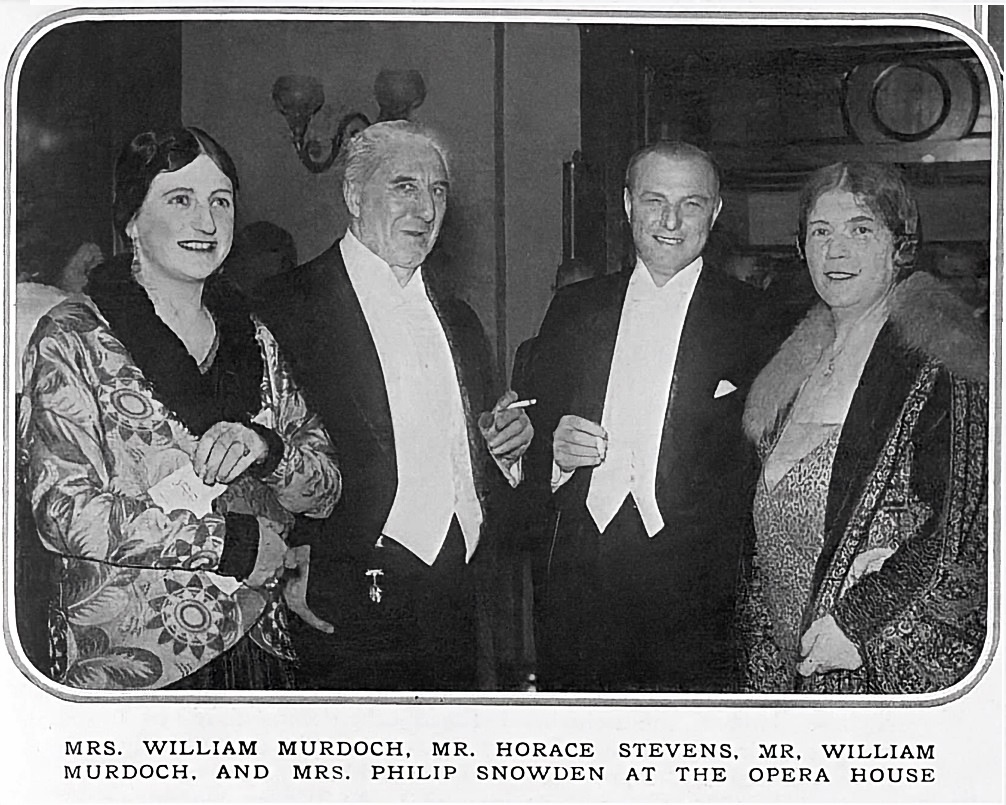 Horace Stevens and "friends" at the re-opening of Covent Garden (photo by Sasha) The Tatler (London), 23 September 1931, p.521
Williams was, like Stevens, a digger in the war driving an ambulance, although one story has him discovered by General Birdwood singing in the trenches of Gallipoli and moved to the entertainment corps. Collier, a little younger than Stevens was a product of Archbishop Thomas Carr, Roman Catholic prelate of Melbourne’s attempt to inject some Catholic blood into an art form that had attracted mostly Protestants.
All these Australians arrived in Britain with extensive musical experience in their home country. Stevens’s background with the Melbourne Philharmonic had grounded him in the repertoire of the great oratorios. It must be remembered that when he made his historic debut as Elijah in Leeds in 1919, he had been performing in the piece since 1888, first as a boy, then in the title role from 1902. As a youth he had observed the great Charles Santley sing the role in 1890. Unlike many Australian singers, his vocal education had been an all-Australian affair. His mother’s life-long friend, Bessie Jukes eased the transition from boy soprano to baritone, and, as he remembered in an interview during his brief return to Australia in 1920, she had coached him on all his repertoire since then, until the war.5
There are several remarkable aspects to the British career of Stevens, not the least being that by 1922 he had performed with Sir Henry Wood, Sir Thomas Beecham, Malcolm Sargent and Adrian Boult. He was introduced to Sir Edward Elgar in 1926 and recorded with him in 1927. He sang with Ralph Vaughan Williams throughout the twenties and premiered his Sea Symphony in the United States. During his visit to North America, he was bass soloist in the American premiere of the Bach B minor Mass with the New York Philharmonic.
All these accomplishments are remarkable, but to that I add his operatic accomplishments. By all accounts not the most animated performer, nevertheless it appears he may have been Australia’s first, native-born Wotan. There is more information coming to light every day, but for now, this brief introduction will help fill in the blanks of an extraordinary time, and an amazing Australian performer.
Australian Singers 1890-1950: A Literature Review
Two books form the principal secondary sources for Australian singers of Horace Stevens’s lifetime: Opera for the Antipodes by Alison Gyger,6 and Singers of Australia by Barbara and Findlay Mackenzie.7 The Mackenzie’s present brief biographies of Australian singers from 1880 to 1966. The book is now dated but when it was written many of these singers were either still alive, or fresh in the memories of people who knew them. As Horace Stevens was a very private man, accounts by contemporary colleagues and friends are a vital window into the life of this great artist.
Opera for the Antipodes is a fascinating overview of the Australian operatic world from 1881 to 1939. The only section that deals with Stevens directly discusses the Fuller tour of 1934-35 in some detail. The book is of great interest also, for information about the Australian cultural world prior to the First World War in which Stevens established his career. The earlier development of opera in Australia in the period between 1861-1880, prior to Stevens, is outlined in The Golden Age of Australian Opera.8 This book is useful as it discusses some of the older singers who sang with the young Stevens, for example the tenor Armes Beaumont.
There are several books which present biographies of individual Australian singers of this period. Four biographies of Dame Nellie Melba are currently extant, plus her autobiography Melodies and Memories.9 Melba’s very presence was such an inspiration to young singers. She regularly returned to Australia to hear and advise young singers, many of whom she took under her wing. At a time when it took a month by steamer to travel between Australia and England, her international schedule was exhaustive.
After Melba, the Australian singer most often written about is the Wagnerian soprano, Marjorie Lawrence. Less familiar to Australians, her career was mainly in North America, where she made regular appearances at the Metropolitan Opera. A famed beauty, her vocation was interrupted by polio. Her autobiography, Interrupted Melody 10 was made into a Hollywood film 11, and recently a biography, Wotan’s Daughter 12 has been published.

Marjorie Lawrence
photo by Delar, N.Y. (1947) - National Library of Australia, Canberra

Florence Austral
National Library of Australia, Canberra
A direct contemporary of Stevens and his partner on both the operatic and concert stage, soprano Florence Austral was the subject of a biography by James Moffat.13 There are some errors in the references to Stevens, particularly regarding his 1927 American concert tour.
Stevens’s famous contemporary, Peter Dawson, also wrote an autobiography, Fifty Years of Song,14 and an excellent biography of this artist was written by Horace Stevens’s last student, Russell Smith.15 Given the popularity of Dawson between 1900-1950, I was initially surprised how little his story connected to Stevens’s career. Dawson’s reputation has been raised to mythical proportions, but during my studies it became clear that he was in a different milieu to Stevens. Although Dawson appeared in the Proms two or three times, and attempted to sing Elijah once, he was primarily engaged for popular entertainment, in which he was a highly-paid success.

Peter Dawson
photo by Harrods (c.1933) - National Library of Australia, Canberra

Harold Williams
National Library of Australia, Canberra
During the 1930s there were three Australian baritones frequently appearing together in reviews and articles: Horace Stevens, Harold Williams and John Brownlee. Brownlee, like Lawrence, is better known in the USA, appearing regularly on the stage of the Metropolitan Opera, and later directing the Manhattan School of Music. He is commemorated in Giovanni: the life and times of John Brownlee by Lloyd Bell.16 Harold Williams is treated in a chapter within Singers of today by Donald Brook.17 Sadly, written after Stevens’s retirement, and a year before his death, Brook’s book does not include Stevens, but is a significant source of information concerning many of Stevens’s fellow performers, including Norman Allin and Muriel Brunskill, who also were part of the 1934-35 Fuller tour of Australia. While the biography Malcolm McEachern: Master of Song by Howard C. Jones documents the life of the Albury-born bass.
Despite the significant presence of Australian singers on the International opera and concert stage at this time, it is remarkable there are so few books detailing their lives and careers. Many of the women are discussed in Roger Neill’s Divas: Mathilde Marchesi and her pupils,18 but material discussing male singers is comparatively sparse.
Understanding the Context.
The accounts of pre-Federation and early Edwardian Melbourne in Manning Clark’s History of Australia 19 illustrate the vibrancy and sophistication of the city, although in country Victoria people were shooting each other. The Kelly gang was formed the same year Stevens was born. The incomplete collection of The Australian Musical News (1911-1963) at the State Library of Queensland 20 and chapter two of The Australian Symphony from Federation to 1960 21 by Rhoderick McNeill also shows how musically sophisticated Australians were during this period.
The era of Stevens’s professional life in Britain between 1919 and 1937 is best understood from the biographies and autobiographies of the conductors and musical leaders of the era. Many of the problems encountered by singers of the age were a direct result of the mighty shadow cast by conductor Sir Thomas Beecham. His efforts to control operatic Britain both during and immediately after the First World War were set against the social and fiscal difficulties that the war had created. Beecham’s autobiography22 finishes at the beginning of 1923, the year Stevens made his operatic debut at Covent Garden as Wotan. The centenary tribute by Allan Jefferson23 did not illuminate the period surrounding 1923, where Beecham left the Garden, and 1931, when he returned. However, the musical politics of the era is well presented in A History of the Royal Opera House. Covent Garden. 1732-1982.24 A key contribution to operatic stabilization was made through the continued political lobbying of publisher William Boosey, which resulted in the Government funding Covent Garden in 1931. This is chronicled in his autobiography, Fifty Years of Music.25
Charles Reid’s biography of conductor Malcolm Sargent26 mentions Stevens in a way that shows his importance in the musical world of Britain at the time. It gives vital information on the preparation and performance of the fabled Hiawatha performances at the Royal Albert Hall.
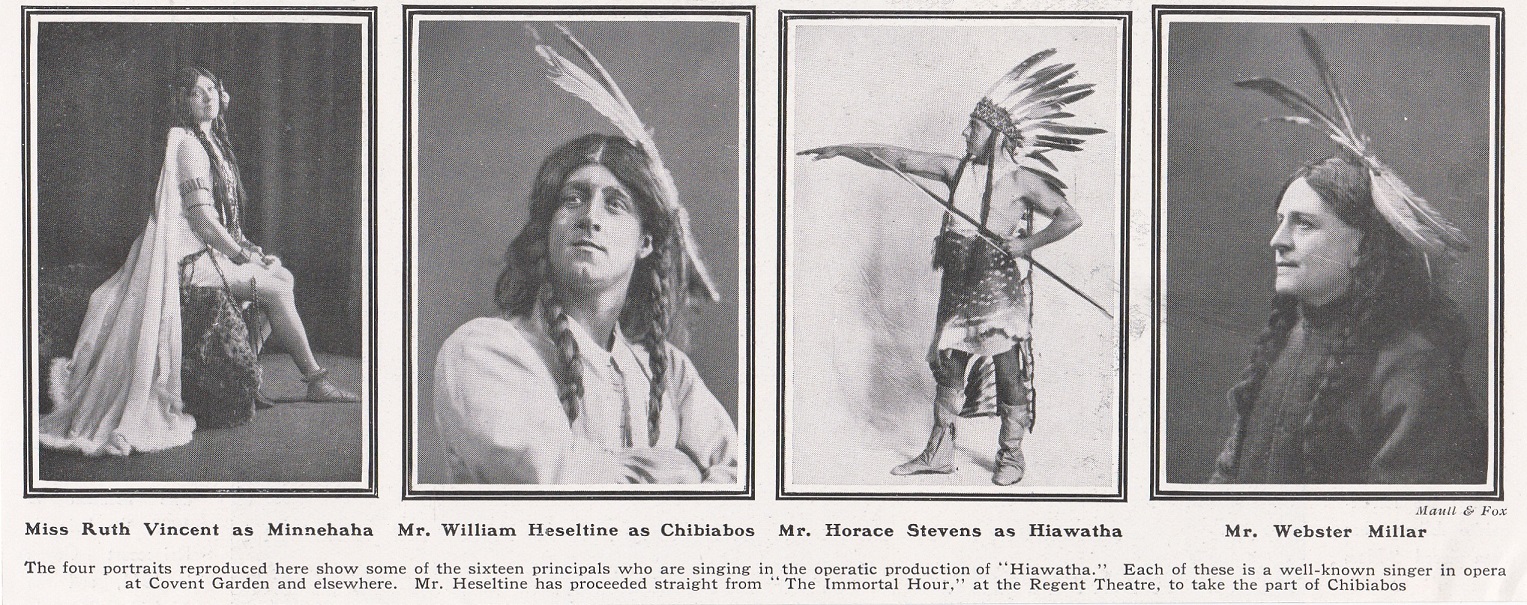 HIAWATHA perfomed as an Opera at the ALBERT HALL, The Sphere (London), Saturday, 24 May 1924, p.11
As Stevens’s professional career was tied so closely to the support of Sir Henry Wood, the related chapters in My Life of Music27 are pertinent. Although Stevens is not directly mentioned, Wood describes the British debut of fabled heldentenor Lauritz Melchior at the Proms. Stevens was the Wotan at that concert, and Wood points out that each singer in the concert performance of Die Walküre sang in their native language.
Finally, the conductor Eugene Goossens’s28 letter to his father en route to take over the Sydney Symphony Orchestra is perhaps more evocative of the personality of the conductor than of the singers he dismisses as teachers in Australia.
What is documented about Stevens?
Aside from Singers of Australia and Opera for the Antipodes, there is little published about Stevens in secondary sources. The essay on Horace Stevens in the Australian Dictionary of Biography29 is a very important source and features some interesting anecdotes. The author, James Griffin, knew Stevens personally, according to his son, and many of the references at the end list ‘private information’. I have been able to access Griffin’s other named sources which include the Mackenzie book, Isabelle Moresby’s Australia makes Music30 and Melbourne Savages by David Dow.31 The Moresby account of Stevens has the friendly, chatty aura of an interview, although it mistakenly puts Stevens’s Covent Garden debut in 1927 rather than 1923. The Dow book is reverential towards Stevens, while detailing some of the robust exploits of the Savage Club members.
A Century of Harmony, the centenary history of the Royal Melbourne Philharmonic Society, by W.A. Carne is a very important source. Through its chronological list of all appearances as the Youth to Sir Charles Santley’s Elijah in 1890 to his final official appearance with the choir in Beethoven’s Ninth Symphony in 1935. He is not mentioned in the cast of Hiawatha in 1939 but did perform in it and was broadcast in the role by the ABC.
There are several mentions of Stevens in Frank van Straten’s National Treasure,32 the story of Gertrude Johnson’s creation of the National Theatre. Stevens and Johnson knew each other when they were performing together in Melbourne before the First World War. Given the tone of some of Stevens’s interviews when he returned to Australia, the germ of an idea to train young singers in stage craft had already taken root by 1934. He assisted Johnson and coached from time to time. Brian Castles-Onion, in his obituary for Robert Allman for The Australian 33 mentioned that young singers were sent to Stevens first, to gauge their suitability in the field of opera.
The Record Collector34 has a fascinating article by Wayne Turner and Graham Oakes which appears to have information that could only be gathered from first hand sources, including a story of the 12-year-old Stevens suffering from stage fright at his first audition. It makes a couple of obvious errors. The contralto for the Santley performances of Elijah was not Adelina Patti, but Janet Patey. However, the article includes some descriptions of Stevens’s performances by colleagues Sir Keith Falkner, Norman Allin and Rispah Goodacre. The Record Collector article claims that Stevens sang in The Golden Cockerel, Madame Butterfly and The Marriage of Figaro, though I have found no press reviews to confirm or consolidate this information.35
Stevens is so closely associated with the three major oratorios of Sir Edward Elgar, particularly The Dream of Gerontius, it came as no mild surprise that he didn’t meet Elgar until 1926, the year before their celebrated collaboration at Hereford Cathedral which produced the magical live recording of ‘Jesu, by thy suff’ring dread’. Michael Kennedy’s essay ‘Some Elgar interpreters’ in the book Elgar Studies36, is effusive in his praise for Stevens’s performance. Bearing in mind the recording itself, (initially re-issued on Lp in 1972 and re-released on CD in 2011), one can only agree. It has been said that the acoustic of Hereford Cathedral was perfectly attuned to Stevens’s voice. One certainly hears none of the American critic’s complaints that sometimes he was drowned out by the orchestra.
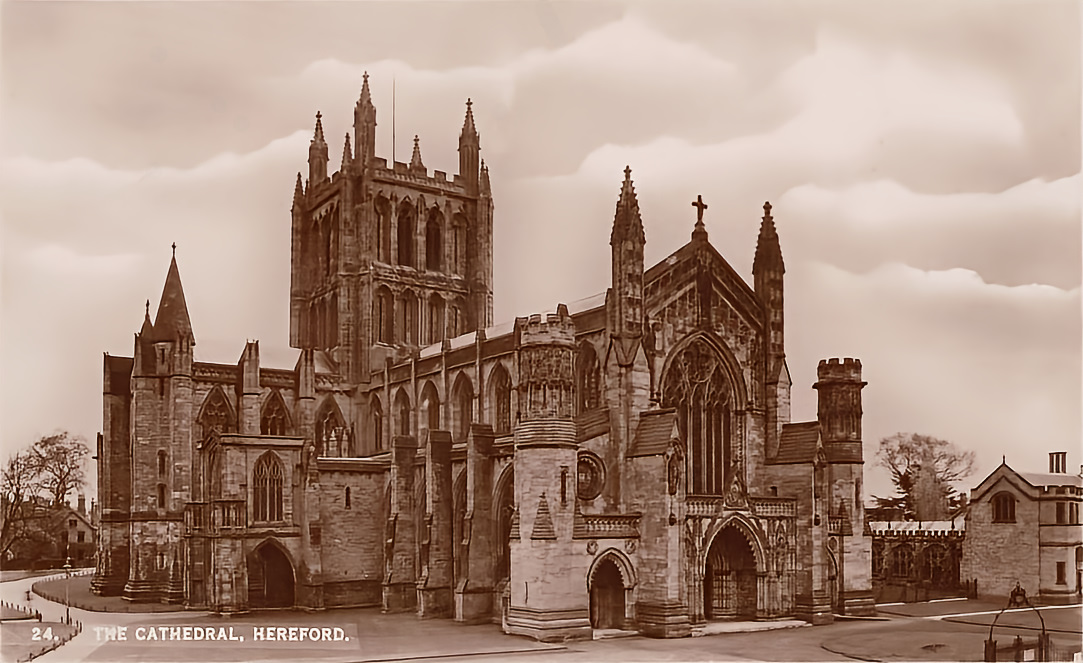
Regarding Stevens’s limited recording career, I was fortunate to obtain a copy of Herman Klein’s contemporary reviews for the magazine The Gramophone.37 Klein is extremely complimentary about Stevens’s voice and, usefully, most of the recordings he reviews are issued on the Truesound Transfers discs discussed below. Klein also provides critical comparisons with contemporary singers in the same repertoire. Most of these recordings are also available for comparison.
Singers to Remember,38 by Harold Simpson, gives a good, if somewhat basic account of Stevens’s career. It ignores his amateur career in Melbourne, and, like many of the later articles and biographies, places his death in 1954. There is also mention of him singing Hagen from Götterdämmerung. The Moffat biography of Florence Austral also states that he took part in a performance of that opera with her. It was never reviewed, if it happened. The excerpts at the Cincinnati May Festival in 1927 contain no Hagen sections.
James Glennon devotes one and a half pages to Stevens in his book Australian Music and Musicians.39 It is a brief and basic account of his life. The dates and repertoire are correct. There is no mention of Elgar and Sir Henry Wood becomes Sir Thomas Wood not once, but twice.
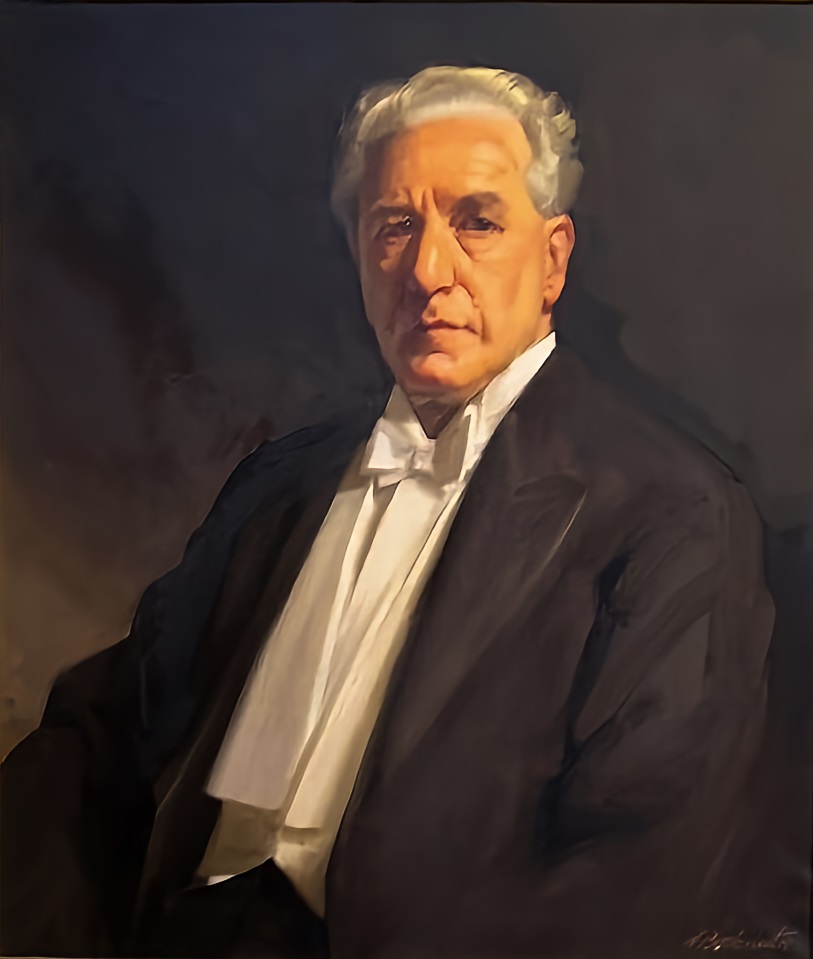 Portrait of Horace Stevens by Ernest Buckmaster (Entered into the 1936 Archibald Prize)
The Recorded Legacy
One of the most challenging aspects of researching Horace Stevens is the difficulty in obtaining recordings, not only of Stevens himself, but also for much of the music he sang, which is no longer fashionable, or requires resources that are, at best, difficult to assemble.
In dealing with Stevens’s recordings, the Eloquence release on Decca,40 Pearl’s 20 Great Bass Arias and songs volume 241 and The Elgar Edition on Warner Music42 (formerly EMI) all contain the same excerpt; ‘Jesu, by thy suff’ring dread’. At the start of my research at the beginning of 2017, YouTube had one Stevens recording; an obscure aria, ‘Sulla Poppa’, from La Prigione d’Edimburgo (Frederico Ricci).43 This performance is of interest because it appears to be Stevens’s only recording not in English (his Italian is impeccable), and that there is no evidence that he sang it in public. The year it was recorded, it was sung at the Proms by Herbert Heyner.
Two volumes of Stevens recordings are available on Truesound Transfers.44 Restored by Christian Zwarg, they contain his important recordings, including the Elijah arias, both in early versions for Vocalion records, and later versions for the fledgling Decca corporation. ‘Hiawatha’s Vision’ is also there, and gloriously sung.
Lastly, there is Elgar’s Interpreters on Record. Volume 5.45 This set contains excerpts from The Dream of Gerontius from 1936, conducted by Adrian Boult. We hear Stevens at 60, about to leave England forever, and despite Boult’s extremely slow tempi, the voice sounds powerful and fresh.
Finally, I needed to familiarise myself with the music Stevens sang. Whenever possible I tried to obtain contemporary recordings or versions that retained similar performance sensibilities. Stevens recorded the arias from Elijah, but the first recording of the complete oratorio was made in 1930 featuring compatriot Harold Williams.46 Sir Malcolm Sargent left an early recording of Handel’s Israel in Egypt47 without bass solos. The bass chorus sings ‘The Lord is a Man of War’. It doesn’t include the interpolated aria from Ezio, ‘Nasce al Bosco’, that Stevens sang, but it presents an interesting insight.
Stevens sang in the British premiere of Handel’s Eracle under Beecham. A later live recording from 1958 at La Scala exists48 that shows an older performance practice with basses singing the castrato roles, now usually undertaken by counter tenors, and the tenor arias sung by Franco Corelli, not a voice we would associate with Handel today. The Vaughan Williams Sea Symphony,49 and the three Elgar oratorios50 are all available under Sir Adrian Boult, with whom Stevens worked on a regular basis. Parry’s Job,51 Coleridge Taylor’s Hiawatha52 and Bantock’s Omar Khayyam53 are available on excellent, modern recordings. Stevens’s repertoire as a boy soprano can be heard on the Nostalgia Naxos release; Master Ernest Lough. Wings of a Dove.54
Leff Pouishnoff, who shared the concert stage with Stevens on his tour of Australia in 1934, can be heard on a double CD set for APR.55 Sadly, his lieder recordings with Walter Widdop are yet to be released.
The performers with whom Stevens shared the operatic and concert stages are available on several excellent compilation CDs, and to finish, to give some of the flavour of the 1920s music scene, Whispering Jack Smith,56 the performer who provided light relief during Stevens’s Armada Concert on BBC Radio, and the Coon-Sander’s Nighthawks,57 who finished off the Cincinnati May Music Festival, after the concert performance of Götterdämmerung, both have dedicated CDs.
To be continued...
Endnotes
1. Many of Stevens’s operatic contemporaries had remarkably brief lives. Caruso was dead at 48; Emmy Destinn, Puccini’s first Fanciulla del West died in 1930 at the age of 52.
2. The Argus, 20 February 1834, p 5. Trove. Accessed 21 March 2017.
3. Michael Broyles, Growth, Change, and Discoveries in the Nineteenth Century, p.57, The Handel and Haydn Society; Bringing Music to Life for 200 Years, The Handel and Haydn Society in association with David Godine, Publisher, 2014.
4. The Times, 29 October 1927, p.10. Trove. Accessed 3 May 2017.
5. Table Talk, 19 August 1920, p.25. Trove. Accessed 19 April 2017.
6. Alison Gyger, Opera for the Antipodes: Opera in Australia 1881-1939, Currency Press, 1990
7. Barbara and Findlay Mackenzie, Singers of Australia from Melba to Sutherland, Lansdowne Press, 1967
8. Harold Love, The Golden Age of Australian Opera. W.S. Lyster and his companies. 1861-1880, Currency Press, 1981
9. https://trove.nla.gov.au/book/resulty?q=Damje+Nellie=Melba Accessed 11 March 2018.
10. https://trove.nla.gov.au/book/result?q=Marjorie+Lawrence Accessed 11 March 2018.
11. http://www.imdb.com/title/tt0048210/ Accessed 11 March 2018.
12. Richard Davis, Wotan’s Daughter. The Life and Times of Marjorie Lawrence, Wakefield Press, 2012
13. James Moffat, Florence Austral. One of the Wonder Voices of the World, Currency Press, 1995
14. http://trove.nla.gov.au/book/result?q=Peter+Dawson Accessed 11 March 2018.
15. Russell Smith and Peter Burgis, Peter Dawson. The World’s Most Popular Baritone, Currency Press, 2001
16. Lloyd Bell, Giovanni: The Life and Times of John Brownlee, [Philadelphia]: Xlibris, c 2002
17. Donald Brook, Singers of Today, Tapp and Toothill Ltd., 1949
18. Roger Neill, Divas. Mathilde Marchesi and her Pupils, Newsouth, 2016
19. Charles Manning Clark, A History of Australia, Melbourne University Press, 1962
20. http://onesearch.slq.qld.gov.au/primoexplore/search?vid=SLQ&searchscope=SLQPCIEBSCO&query=any,contains,Australian%20Musical%20News
21. Rhoderick McNeill, The Australian Symphony from Federation to 1960, Chapter 2, Ashgate, 2014
22. Sir Thomas Beecham, A Mingled Chime, Hutchinson and Co., 1944
23. Alan Jefferson, Sir Thomas Beecham. A Centenary Tribute, MacDonald and Jane’s, 1979
24. Andrew Saint, B.A. Young, Mary Clarke, Clement Crisp, Harold Rosenthal, A History of the Royal Opera House: Covent Garden. 1732-1982, The Royal Opera House, 1982
25. William Boosey, Fifty Years of Music, Ernest Benn Limited, 1931
26. Charles Reid, Malcolm Sargent. A Biography, Hamish Hamilton, 1968
27. Sir Henry Wood, My Life in Music, Victor Gollancz. Ltd., 1938
28. Carole Rosen, The Goossens. A Musical Century, Andre Deutsch, 1993
29. http://adb.anu.edu.au/biography/stevens-horace-ernest-8653 Accessed 1 March 2017.
30. Isabelle Moresby, Australia Makes Music, Longmans, Green and Company, 1944
31. David M. Dow, Melbourne Savages: A History of The First Fifty Years of The Melbourne Savage Club, The Melbourne Savage Club, 1947
32. Frank Van Straten, National Treasure. The Story of Gertrude Johnson and the National Theatre, Victoria Press, 1994
34. Wayne Turner. Graham Oakes, The Record Collector. Vol. 46. No. 3, Editor: Larry Lustig, September 2001
35. The absence of Horace Stevens in the credits for such productions listed in J.P. Wearing's The London Stage 1920-1929 and The London Stage 1930-1939 [Scarecrow Press. 1984] indicates that such performances took place outside of London.
36. Raymond Monk (editor), Elgar Studies, Scholar Press, 1990
37. William R. Moran (editor), Herman Klein and The Gramophone. Collected Reviews. 1923-1934, Amadeus Press, 1988
38. Harold Simpson, Singers to Remember, The Oakwood Press
39. James Glennon, Australian Music and Musicians, Rigby Limited, 1968
40. Decca Eloquence, From Melba to Sutherland. Australian Singers on Record, Compilation Producers: Tony Locantro and Roger Neill, 482 5892
41. Pearl, 20 Great Bass Arias & Songs. Volume II, GEMM CD 9173, Pavilion Records Ltd.
42. Warner Classics, The Elgar Edition, 9 CD. 50999 95694 2 3 Mono ADD.
43. https://youtu.be/WSXzyhUh288
44. Horace Stevens 1. TT-3002. Horace Stevens 2. TT-3003. Source Materials provided by Chris Mankelow (Sunday Opera records). Christian Zwarg Compilation, discographical research and digital audio restoration: Christian Zwarg.
45. Elgar Editions, Elgar’s Interpreters on Record. Volume 5. EECD003-5 Broadcasts from the Leech Collection at the British Library. (1935-1950) add Mono.
46. Divine art. HISTORIC SOUND. Mendelssohn: Elijah. 27802 mono ADD
47. Dutton, G.F. Handel: Israel in Egypt , CDLX 7045
48. MYTO., G.F. Handel. Eracle, 2 CD 00159
49. Warner Classics, British Composers. Vaughan Williams. The Nine Symphonies, Sir Adrian Boult. 5099 0 87494 2 3 Stereo ADD.
50. Warner Classics, Elgar Choral Works, Sir Adrian Boult.0946 3 67931 2 2 Stereo ADD.
51. Hyperion, Sir Hubert H. Parry, Job. CDA67025 DDD
52. Argo, Scenes from the Song of Hiawatha, The Decca Record Company. 430 356-2 ZH2
53. Lyrita Itter Broadcast Collection, Granville Bantock, The Complete Omar Khayyam, Norman Del Mar. BBC. REAM.2128
54. Nostalgia Naxos, Master Ernest Lough. Wings of a Dove, ©2005, Naxos Rights International. 8.1 2083 2
55. APR Leff Pouishnoff, The Complete 78 rpm and Selected Saga LP Recordings, APR 6022
56. Flapper, Whispering Jack Smith, Past CD. 7074
57. ASV Mono. Living Era,. Everything is Hotsy-Totsy Now. The Coon-Sanders Nighthawks, CD AJA 5199
-
Horace Stevens (Part 3)
 DAVID HIBBARD's overview of the life and times of the Australian bass-baritone Horace Stevens continues with Part 3.
1903–1919
In 1903 Stevens reprised his roles in Gounod’s Mors et Vita and Handel’s JudasMaccabeus, in Adelaide. An interesting footnote to the performance of the Gounod is the review in the Melbourne Age; “Mr Horace Stevens is so zealous and painstaking a singer that it is a pity his method of production is one not conducive to clarity of tone; there is so often a perceptible ‘buzz’ such as one hears in a bassoon”.1 What the critic refers to as ‘buzz’ one can hear on his later recordings. It is a result of a highly-placed focus on the voice. It allows the amazing tonal flexibility Stevens could achieve but was not always pleasing at the time. As one reads so often, the ultimate achievement of the fin de siècle singer was purity of sound, rather like the ‘Early Music’ specialists that were popular in the 1990s.
On 29 September 1903, he added to his repertoire Handel’s Israel in Egypt. In the version of the score used today the duet for two basses, ‘The Lord is a Man of War’, is the only contribution of that voice type. W.A. Carne lists only one bass, Mr Horace Stevens,2 who sang an additional aria titled ‘Wave on wave, congealed in thunder’. According to performance practice during the first half of the twentieth century, an additional bass aria was adapted from Handel’s opera, Orlando (1733), originally Sorge in fausta una procella.3 The critic for the Argus praised it as a “very laudable Handelian rendering”. He also observed that the tremolo that was present in Stevens’ early performances had gone, and he has a “much better voice”.4 On 24 December 1903, Stevens performed ‘The Toreador’s Song’ from Bizet’s Carmen for the first time, an aria that was to have a profound effect on his career in the future, in a Christmas ‘Smoke Concert’ with the Royal Melbourne Liedertafel.5

Concert d’Adieu of Mr Armes Beaumont, Town Hall, Melbourne, 31 January 1903
State Library Victoria, Melbourne

Concert by the Lyric Orchestra, Town Hall, Melbourne, 23 November 1904
State Library Victoria, Melbourne
In 1904 Stevens had only one engagement with the Royal Melbourne Philharmonic Society, a repeat of Gounod’s Redemption.6 In June, Stevens sang in the title role of Rossini’s Moses in Egypt in a concert performance by the Lyric Orchestra, conducted by Charles Levy. “The character, vocally, is one of great difficulty. Mr Stevens, who has a rich, fluent bass voice, letter perfect, got clean home to the hearts of his audience. It was a fine effort—one of the best he has accomplished”.7 In August, Horace and Emilie performed Elijah once again, this time in Geelong. They both received glowing praise.8 The other new repertoire for the year was an appearance with Emilie in what was described by the Argus as “Haydn’s 16th Mass”. The performance was before the Governor General and Lady Northcote at the Melbourne Town Hall. Among the encores, Horace sang Robert Schumann’s ‘The Two Grenadiers’ which was judged “finely interpreted”.9 In December, Horace was best man for William George Frederic Steele, who married Emilie Stevens at Scots Church, Collins Street. 10
By 1905, Horace Stevens was an established singer in Melbourne. He was assisting in his father’s dental surgery in Collins Street, he was rowing competitively, played cricket and hunted. His performances with the various Liedertafel around Melbourne were well received, and his recital repertoire was well-formed. In April he sang with the Royal Melbourne Philharmonic in Gounod’s Mors et Vita.11 In August, he sang the demanding role of Mephistopheles in Berlioz’s Damnation of Faust, a classic ‘Basse Chantante’ part of French repertoire. There were two reviews: “Mr. Horace Stevens sang the part of Mephistopheles with great vigour and dramatic feeling, and his rendering of the ‘Serenade’ and ‘The Flea Song’ was capital, though the speed at which both were taken was excessive”.12 “Mr Horace Stevens did well in the important role of Mephistopheles and sang the Flea song and the Serenade with good effect; the latter was for the first time on local record taken at the proper rate of speed”.13

St Paul’s Cathedral, 1905, before the addition of the spire
State Library Victoria, Melbourne
On August 26, Horace married Nellie Chapman at St Paul’s Cathedral in a fully choral service. The wedding was a high end, glamorous affair, and described in detail in the “Novelties of the Season” section of The Australasian.14 The wedding reception was held at the Pianola Hall, in Collins Street, which is where the Kodak building now stands [now occupied by The Hour Glass].
In January 1906, Horace, billed as the “Premiere Scottish Soloist of Melbourne”, accompanied by fellow singers Gregor Wood and Madame Gregor Wood embarked on a series of concerts in Hobart and Devonport. Accompanied by a band of ten highland bagpipers, they were very popular, particularly “Mr Horace Stevens has a-baritone voice of great power” singing ‘Scots wha hae wi’ Wallace bled’ which had to be encored.15
In May Horace travelled to Ballarat to perform, once again, Elijah.
In September 1906, Nellie gave birth to twin boys. The children are unnamed in the announcement. Horace and Nellie had three sons, Kemble, Souther and Dudley. A fourth child, a boy named Ernest, died in 1907. From the birth notices it is surmised that Kemble and Souther were the twins, and that Dudley was born in 1910. Dudley appears to be the only one to attempt to follow his father into the Arts.16
Sir Edward Elgar’s oratorio The Apostles Op. 49 had its Australian premiere on 14 August 1906 at the Melbourne Town Hall, just three years after its very first performance at Birmingham. “Every part of the Town Hall was crowded. Extended press accounts to 14” commented on the new work as well as the performance” (the renovated organ was used).17 Stevens sang the part of Peter. It would have suited him perfectly, as it is more baritone-like than the other two parts requiring low men’s voices, the role of Jesus, sung by A.C. Bottoms, and the bass role of Judas, sung by Andrew Black, the role he had created under Elgar’s direction. Miss Lillian Reed sang Mary, Madame Gregor Wood sang Magdalene, and Gregor Wood, St John.18

Damnation of Faust, Town Hall, Melbourne, 1 August 1905
State Library Victoria, Melbourne

Mose in Egitto, Town Hall, Melbourne, 20 June 1907
State Library Victoria, Melbourne
In March 1907, the Royal Melbourne Philharmonic performed Louis Spohr’s Calvary. The two lower-voiced protagonists are Judas Iscariot, and St Peter. Stevens sang the part of Judas. The reviewer for the Age wrote, “Mr A.C. Bottoms sang Peter’s ‘Tears of Sorrow’ effectively enough, and Mr Horace Stevens was very acceptable in ‘Woe, Horror, Grief’.19 The critic for Punch wrote of both singers, “Mr A. Bottoms, a broad, manly ringing baritone, always dramatic, accurate and telling, made a fitting herald to the fine basso cantante, Mr Horace Stevens.”20
In August 1907, Stevens took on parts one and two of the Hiawatha trilogy for the Philharmonic, adding Hiawatha’s Wedding Feast to his repertory. In November, the Royal Victorian Liedertafel performed Elgar’s The Dream of Gerontius. The performance was widely praised. “Mr Horace Stevens doubled the parts of the Priest and the Angel of the Agony. He has a fine, dramatic bass voice, and being in exceptional form, gave a most realistic reading of the music allotted these two sombre characters”.21 This was to become one of Stevens’s most important roles in Britain during the 1920s and 30s.
Stevens added two important pieces to his repertoire during 1908. He performed the Prologue from Pagliacci (composed by Ruggero Leoncavallo 1857–1919, and first performed in 1892) at a Liedertafel concert in Adelaide for the Caledonian Society in June.22 This piece became a staple of future recitals. He recorded it twice, both times in English. In baritone Michael Lewis’s opinion, of all the repertoire Stevens sang, this aria seemed the most surprising, as it sits much higher than his other repertoire, but he may never have sung the role of Tonio in its totality on the stage and performed the aria only.
In August 1908 the Royal Melbourne Philharmonic performed the Australian premiere of Elgar’s The Kingdom, only two years after its composition for the Birmingham Triennial Festival. The work follows on from The Apostles in telling the story of the early church after the departure of Christ. The critic for the Australasian felt that “on the whole the work appeals less to the popular audience than its predecessor … Mr Horace Stevens, as Peter, distinguished himself by his noble, dramatic rendering of the part. It is the most important of the four, and he sang it admirably”.23 The easy beauty and size of Stevens’s voice could have been tailor-made for these Elgar oratorios, with their lush orchestrations, and romantic melodiousness. Stevens’s performance must have impressed George Peake, then music director of the Philharmonic, because he was back performing Messiah that year following several years of being overlooked. Between 1909–1910 he was engaged by the Society as a principal soloist in The Redemption, Messiah, Mors et Vita and the Apostles. He sang the hymn ‘Nearer my God to thee’ in leading the congregation at the commemoration of the death of King Edward VII.24
In April 1911, now 35, Stevens performed as Christus in the St. Matthew Passion by J.S. Bach for the Royal Melbourne Philharmonic Society. The piece had not been performed in Melbourne for thirty-five years.25 The work was repeated in 1913 and received the following favourable review “Of the chief soloists, chief honours fall to Mr Horace Stevens, who brought considerable sympathy in his interpretation of the music allotted to the words of Christ”.26 It shows the virtues that were the hallmarks of Stevens’s singing. Impeccable diction and phrasing, plus a sensitivity that belied the true size of his voice.
Apart from dentistry and singing, Stevens’s other great passion in life, to which he referred in interviews into old age, was his passion for rowing. In 1911 Stevens won the sculls at the Henley on Yarra regatta. Representing Essendon in the Yarra Challenge Sculls, he pipped K.J. Kirby of the Civil Service at the post to take out the championship.27

Program cover for The Messiah, Exhibition Buildings, Melbourne, 1911
State Library Victoria, Melbourne

Maria Voluntas Ranzenberg in costume for Dalila for the Melba opera season, 1911, photo by May Moore
The Australian Musical News, November 1911
Alberto Zelman took over directorship of the Philharmonic mid-1911. Melba was touring Australia at the time, and the opportunity was taken to secure two of her supporting artists as soloists for the annual Messiah alongside Stevens, namely German contralto, Maria Voluntas Ranzenberg and Irish tenor John McCormack. McCormack was, at the time, one of the great tenors of the world, and it was a great coup to have him in Australia, let alone on the stage of a sold-out Exhibition Building. Table Talk praised the beauty of his voice but bemoaned the fact that there was so little music in which to hear him. “The local artists have often been heard. Mr Horace Stevens as usual was most successful in the baritone music, especially the dramatic portions, but in the quieter parts, such as ‘But Who May Abide’ his voice does not tell in such a huge building as the exhibition”.28 This criticism was levelled at him frequently in later years as he attempted to interpret the quieter dynamics in Wagner.
Throughout 1912 and 1913 Stevens kept busy with Philharmonic performances of TheDeath of Minnehaha, the St Matthew Passion and Elijah, the latter in Geelong.29 He also sang the bass part in the finale of Beethoven’s Choral Symphony.30 In April 1914, Stevens performed Mors et Vita twice more at the Melbourne Town Hall, with the Philharmonic.31 Despite the outbreak of war on 4 August, in the summer two performances of Messiah involving Stevens were given to sell-out houses at the Melbourne Town Hall, with Zelman’s Melbourne Symphony Orchestra accompanying the soloists and chorus for the first time.32

Elijah, Geelong Musical Society, 1913
State Library Victoria, Melbourne

Stevens had been a member of the Melbourne Savage Club since 1898, when he gave his first smoke concert at their rooms.33 In March 1915, the club performed a variety concert for the Belgian Relief fund. Songwriter, and fellow Savage Horace Gleeson (1878–1959, and composer of ‘I thought I heard a magpie calling’) re-wrote the choral section to Beethoven’s 9th Symphony, titled ‘A Hymn to hate’. Horace sang it.34 The Royal Melbourne Philharmonic donated the takings of that year’s performance of Judas Maccabeus, featuring Stevens, to the ‘Wounded Soldiers Fund’.35

Farewell Complimentary Concert to Lieut. Horace Stevens, 25 April 1916
ABE Books
When the First World War began, the Australian Imperial Forces had no specialised Dental Unit. Dental maladies were treated by the general medical units, as was standard practice in the British Army. The nightmare of Gallipoli in 1915, where outbreaks of ulcerative gingivitis or ‘trench mouth’, were common and insufficiently treated, caused the creation of Dental Units. By April 1916 the Australian Army had 36 fully equipped Dental Units. Three dental sections were attached to each division, and one to each field ambulance. The Australian Dental Corps, by 1918, was leading the world in Dental practice, with a standing order that no teeth were to be extracted, if they could be saved.36 Thus, the Australian Army needed experienced dentists, and in 1916 Horace Stevens enlisted into the 14th Field Ambulance, AIF, as ‘Honorary’ Lieutenant. This fact was announced in Punch on 6 April; “We hear that Mr Horace Stevens, a leading baritone of this city, will leave shortly for our military centres in the East. He will take a hand in caring for our soldiers’ teeth; Mr Stevens is also a Dentist, and his qualifications in this direction are quite as finished as they are in a vocal way. This is for public information.”37
On 2 May he gave a complimentary concert at the Town Hall in Melbourne, a concert patronised by Madame Melba, who was also in attendance.38 Mr J. Sutton-Crow accompanied. For Melba to have been present gives a measure of Stevens’s standing in the community at the time, and one can only marvel at a thirty-nine-year-old leaving his wife and three sons under ten. Furthermore, his father, Horace Stevens senior, died on 19 May.39 Horace Junior embarked for France the following day, on the HMAT Medic A7.40
Honorary Lieutenant Horace Stevens disembarked at Devonport, in Britain, from the Demosthenes, on the 18th of July 1916. The journey usually took around a month, but the new members of the Dental Corps disembarked in Egypt, where they collected clay to assist in their making of dental molds. The thirty-nine-year-old was listed as a British Subject and belonged to the Church of England. He stood 5 feet 10 ½ inches tall (179 cm) and weighed in at 12 stone (76 kg). Normal eyesight and an exceptional chest expansion of 36 inches to 40 inches (91inches-101 cm) made up the complete package. A photograph held at the Australian War Memorial shows him with a group of fellow officers of the Dental Corps, looking exceptionally dapper, and wearing jodhpurs and riding boots.


He was appointed the Officer commanding the 50th Dental Unit, attached to the newly formed 3rd Division of the Australian Imperial Force. Following the disaster of the Gallipoli campaign in 1915, the Australian Command realized the importance of keeping the soldiers entertained, and relaxed the rules regarding leave for entertainers, which was normally only one week per three months service. Stevens’s advanced years and reputation in Australia, it would appear, allowed him to appear in non-military concert work.41 On Monday, October 30th, 1916, he appeared in Belfast at a fund-raising concert for the Post Office, sharing the stage with, amongst others, soprano Dorothy Silk (1883–1942) and Bass Robert Radford (1874–1933)42 Silk was to establish herself as a champion of British Music during the twenties, while Radford, although only two years Stevens’s senior, was an established singer. He had made his debut at the Norwich Festival in 1899, and in 1904 had made his Covent Garden debut as the Commendatore in Don Giovanni, as well as appearing as Fasolt in the Ring Cycle under Hans Richter. In the Northern Whig, the singers were enthusiastically praised; “Mr. Radford’s resonant bass was used with artistic judgement”. “Lieutenant Horace Stevens infused the right spirit into his interpretations of the martial songs ‘The Two Grenadiers’ (Schumann), and ‘The Song of the Gun’ (Allister)”.43
On the 16th of November, Lieutenant Stevens was then attached to the Machine Gun Training Depot at Grantham. In a letter to the sporting magazine, Winner, in 1917, a second Lieutenant Pitman attended a concert at Grantham, given by the Melbourne oarsman/vocalist, Captain Horace Stevens,44 while in the same month, Melbourne Punch reported that Captain Stevens had visited Dublin on leave. There “he made several public appearances, where his singing created quite a furor”.45
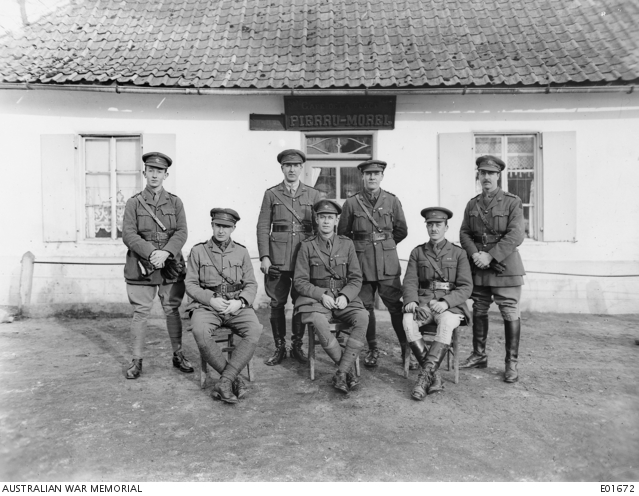
Stevens’s promotions were quite rapid. He was promoted from honorary Lieutenant to full lieutenant on the 6th of April 1917, and then to full captain eleven days later the 17th of April. On the 7th of August 1917 he was brought to the notice of the Secretary of State for War, George Barnes (1859–1940), leader of the Labor Party in the Lloyd George coalition “for valuable services rendered” Military Order 576/17.46
Ireland had experienced the Easter Uprising in 1916. There was Australian involvement in quelling the rebellion, but the AIF records for this were destroyed in the late 1950s by the staff of the Australian War Memorial.47 That same year the Roman Catholic Coadjutor Bishop of Melbourne, Daniel Mannix was denied permission to visit Ireland. Rumors of Australian war crimes had seeped back to Australia, and with a quarter of the population claiming Irish Catholic paternity Horace’s popularity with the Irish may have gone someway to easing tensions and taking the heat out of an Australian diplomatic incident.
Further to this, Ronan McGreevy for the Irish Times points out the general British fear of an Irish takeover of Australia.48 This had gone right back to the Crimean War of 1853–1856 where the Australian colonies had been less than enthusiastic about providing financial backing for the British endeavor. 1916 was the first Australian plebiscite on conscription, which went against the Government of Billy Hughes. The following year the British government agreed to pay more for Australian wheat in an effort to sway the 1917 plebiscite, but again Hughes was defeated.
A third possibility rests with the importance the Australian General Staff placed on keeping soldiers entertained. Ireland was a popular destination for deserters, who, with the aid of Sin Fein, could obtain civilian clothes and disappear into the Irish countryside. Perhaps a voice from home might have lured them back to their duty as sons of the Empire!

Horse Ferry Road—Headquarters of the AIF during the war
Horace was amongst the soloists announced in the Belfast Newsletter of September 1917 for a performance by the Belfast Philharmonic Society the following year of Sir Granville Bantock’s ‘The Fire Worshippers’.49 On the 30th of November he was moved briefly to Administration Headquarters at Horseferry Road, London, until, on the 5th of December a stamp appears in his war record “Proceeded overseas France”. There he joined number 32 Dental Hospital.
The Belfast Newsletter of the 23rd of March 1918 carried a review of the performance of ‘The Fire Worshippers’, but reviewed Mr. J.F. Newell “acting as substitute for Captain Horace Stevens, who is unfortunately seriously ill”.50 It would appear the stressful conditions of the Western Front would be too much for the 42-year-old. On the 22nd of February 1918, just over two months caring for the ill and facially injured souls of the Australian Imperial Forces, Stevens was admitted to a dressing station with “Sub acute Rheumatism”. On the 23rd he was moved to another station and on the 26th to the Canadian General Hospital Dannes Camiers (Pas de Calais), where he was diagnosed with Myalgia. It was his ticket home, and on the 5th of March 1918, he found himself at the London General Hospital, Wandsworth.
The contemporary medical record for Horace states that he was suffering from the “sudden onset facia in left shoulder radiating down arm. Loss of power of grip. Has had two previous attacks of rheumatism”. A modern diagnosis reads as follows; “Centrally mediated chronic myalgia is a chronic continuous muscle disorder, originating in the central nervous system, which generates symptoms at the periphery of muscle tissues. Pain at rest is the key factor of the clinical characteristics of this disorder and probably occurs due to the sensitization of the muscle nociceptors by algogenic substances released in the neurogenic, inflammatory process”.51 One doctor has written “heart good” at the bottom of his medical notes, which, of course, must have been a worry to a middle-aged dentist on the front line.
Many articles on myalgia and dentistry talk about the splitting stress headaches, which are a constant companion, so he must have been in constant agony. One can imagine that having been part of one of Melbourne’s better dental surgeries, suddenly being thrust into the rough and ready atmosphere of the front line must have been extremely stressful. The regimental diary for the week before Horace was admitted to hospital notes that a sortie behind enemy lines had been ordered, and that medical staff were to be prepared for extra casualties. He remained in hospital, in terrible pain for two months, released to convalesce on the 9th of April 1918.

Postcard for the Imperial Restaurant, c.1920

Mrs Hamilton Earle (Louise Dale)
From The Tatler, 10 March 1920
The Australian Imperial Forces utilized The Imperial Restaurant in Regent Street for their Masonic members. The Imperial Restaurant was a grand establishment in a flamboyant Edwardian style, with much stonework and private tables. Their menu featured portraits of the late Edward VII, the current George V and the future Edward VIII. It was there that Horace found himself on Armistice night, the eleventh of November 1918. ‘The War to end all Wars’ must have left the world in a state of painful numbness, and doubtless many crowded into the streets to drink away the horror which they must have thought would never end.
His table, at some stage in the evening, persuaded Horace to sing, and he obliged the company with ‘The Toreador’s Song’ from Carmen, by Bizet. An Australian lady at the table, a Mrs. G.H. James was greatly impressed, and later introduced Horace to a Mrs. Earle, an Australian soprano who had performed at the 1916–17 Proms under Sir Henry Wood as Louise Dale.52 Mrs. Earle was able to get Captain Stevens to audition for the great conductor. A letter from Sir Henry to Mrs. Earle and forwarded to Mrs. James read “You will be pleased to hear I am delighted with Captain Horace Stevens, and that he is really studying most seriously. He sang magnificently Wotan’s Abschied at a Wagner night at the Promenades, and his voice came over the orchestra quite superbly. I have recommended him for the Birmingham festival Choral Society, and for Amfortes [sic] in Parsifal with the Liverpool Philharmonic Society, so he is really getting on.” This from an interview given by Mrs. James on her return to Australia in 1920. She concluded, rather unfairly I believe, with “Mr. Stevens, though a huge favorite in Melbourne, was not given any great opportunity as a vocalist”!53
A problem facing the Australian Imperial Force at the end of hostilities was how to occupy an army, while they were waiting for repatriation to Australia. The Australian government set up the Non-military Employment Scheme, whereby all soldiers were required to fill out AIF Demobilisation Form 534, listing their full-time career intentions, prospects of employment, wishes for education, retraining and employment while awaiting repatriation. The Government would pay for a certain amount of retraining. The scheme started on the 17 December 1918.54

Sir Henry Wood, 1919
Birmingham City Council
Stevens later recalled his version of these events in a speech he gave to the Centenary Club in 1935. “He recalled that under the non-military employment scheme, instituted at the end of the war to help returned soldiers to re-equip themselves for their old professions and trades, the famous conductor applied for his services, but was refused because, it was pointed out that Mr Stevens’ attestation papers had labelled him a dentist. The departmental attitude was that there was no reason why he should waste his time dabbling in music when he could be assiduously regaining his old employment as a dentist”.55

Letter from Henry Wood to the Director of Education, AIF, 26 July 1919
National Archives of Australia, Canberra

The records also contain a letter from Sir Henry Wood himself to substantiate Stevens’s letter. Lessons with Sir Henry had started on 15 April 1919. Wood’s letter states that the experience gained from his concert engagements would be of the greatest value on his return to Australia as a “teacher and vocalist”. By this stage Stevens was sending his entire military wage to Melbourne to support Nellie and the boys, while he lived on his earnings as a singer. Even Lieutenant General Sir John Monash wrote to support Stevens, but the bureaucracy won out, and on the 20 October 1919 his application for discharge in the UK was cancelled.57
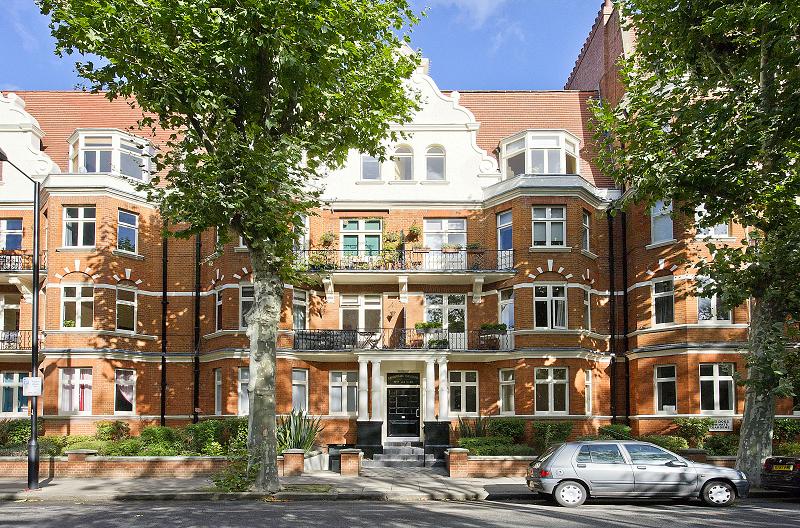 Horace's London residence in Maida Vale
Nevertheless, his concert appearances proceeded. On Monday 29 September 1919, Horace Stevens made his Promenade Concert debut in Concert No. 38 at the Queen’s Hall, London, under the direction of Sir Henry Wood. In an all-Wagner program he sang ‘Wotan’s Farewell’, with ‘The Magic Fire Music’.58 That year he also sang Elijah under Wood’s baton in Birmingham. The next day the London Morning Post critic hailed him as “the greatest Elijah since Santley”.59 On 4th July 1919 he appeared in a post war celebration at the Brand Lane concerts, sharing the stage with Madame Melba, Dame Clara Butt, Elsa Stralia and the pianist/composer Busoni.60
To be continued...
Endnotes
1. The Age (Melbourne), 11 April 1903, p.10. Trove. Accessed 28 July 2017.
2. W.A. Carne, A Century of Harmony: The official Centenary History of the Royal Melbourne Philharmonic Society,Royal Melbourne Philharmonic Society, Melbourne, 1954, p.135.
3. Jason Lester, Antonio Montagnana: Progression of a Handelian Bass, Florida State Universities Library, Electronic Theses, Treatises and Dissertations. 2006, p.39. Accessed online 30 July 2017, https://fsu.digital.flvc.org/islandora/object/fsu:181469/datastream/PDF/view
4. The Argus (Melbourne), 30 September 1903. Trove. Accessed 28 July 2017.
5. The Age (Melbourne), 22 December 1903, p.8. Trove. Accessed 19 April 2017.
6. Ibid, Carne, p.136.
7. Punch (Melbourne), 27 June 1907, p.29. Trove. Accessed 21 July 2017.
8. Geelong Advertiser, 25 August 1904. Trove. Accessed 14 June 2017.
9. The Argus (Melbourne), 24 November 1904, p.5. Trove. Accessed 30 July 2017.
10. Table Talk (Melbourne), 8 December 1904, p.20. Trove. Accessed 1 July 2017.
11. ibid, Carne p.137.
12. ‘Music’, The Age (Melbourne), 5 August 1905. Trove. Accessed 30 July 2017.
13.‘Amusements’, The Argus (Melbourne), 2 August 1905. Trove. Accessed 31 July 2017.
14. The Australasian (Melbourne), 2 September 1905, p.44. Trove. Accessed 12 July 2017.
15. The North-Western Advocate and Emu Bay Times, 19 January 1906. Trove. Accessed 7 July 2017.
16.‘Family Notices’, The Age, 23 June 1906. Trove. Accessed 12 July 2017.
17. Ibid, Carne, p.139.
18. Ibid, Carne, p.139.
19. The Age (Melbourne), 30 March 1907, p.10. Trove. Accessed 17 April 2017.
20. Punch (Melbourne), 4 April 1907, p.29. Trove. Accessed 17 April 2017.
21. Punch (Melbourne), 7 November 1907, p.30. Trove. Accessed 17 April 2017.
22. The Register (Adelaide), 30 June 1908, p.6. Trove. Accessed 7 June 2017.
23. The Australasian (Melbourne), 15 August 1908, p.28. Trove. Accessed 7 June 2017.
24. Gippsland Times, 23 May 1910, p.3. Trove. Accessed 23 November 2017.
25. ibid, Carne, p.146.
26. The Age (Melbourne), 22 March 1913, p.11. Trove. Accessed 22 August 2017.
27. Tasmanian News (Hobart), 28 October 1911, p.4. Trove. Accessed 7 June 2017.
28. Table Talk (Melbourne), 28 December 1911, p.10. Trove. Accessed 3 August 2017.
29. The Geelong Advertiser, 27 October 1913, p.4. Trove. Accessed 14 June 2017.
30. ibid, Carne, pp.153–154.
31. ibid, Carne, p.154.
32. ibid, Carne, pp. 156–157.
33. David M. Dow, Melbourne Savages. A History of the First Fifty Years of the Melbourne Savage Club, Melbourne Savage Club, Melbourne, 1947.
34. Punch (Melbourne), 13 May 1915, p.8. Trove. Accessed 21 June 2017.
35. ibid, Carne, p.157.
36. Ian Finlayson—Australian Army History Unit, Pull the Other One!—Dentistry in the 1st AIF. Accessed online, 7 June 2017, https://www.army.gov.au/our-history-in-focus/pull-the-other-one-dentistry-in-the-1st-aif
37. Punch(Melbourne), 6 April 1916, p.44. Trove. Accessed 14 June 2017.
38. The Essendon Gazette and Keilor, Bulla and Broadmeadows Reporter, 27 April 1916. Trove. Accessed 14 June 2017.
39. Ringwood and Croydon Chronicle, 19 May 1916. Trove. Accessed 14 June 2017.
40. Australian War Memorial. Accessed online 7 June 2017, https://www.awm.gov.au/collection/R1936838
41. Shelley Blakely, Information Services/ Research Centre. Australian War Memorial,
This email address is being protected from spambots. You need JavaScript enabled to view it. 42. Belfast Newsletter, 28 September 1916.
43. Northern Whig, 31October 1916.
44. Winner, 26 September 1917, p.26.
45. Punch (Melbourne), 13 September 1917, p.26.
46. Australian War Memorial.
47. Dr. Jeff Kildea, Called to Arms: Australian Soldiers in the Easter Rising 1916. Australian War Memorial.
48. Ronan McGreevy, http///www.irishtimes.com/culture/heritage/British-feared-irish-takeover-of-australia-in-1916-1.2687874
49. Belfast Philharmonic Society, Belfast Newsletter, 21 September 1917.
50. Belfast Philharmonic Society, Belfast Newsletter, 23March 1918.
51. Franischetti; Ferraz Junior; Ferreira; Carvalho; Guimaraes. Chronic Myalgia centrally medicated. (Myalgia cronica mediada centralmente), http//dx.doi.org/10.1590/1981-86372014000200000161437
52. Table Talk (Melbourne), 22 January 1920. Trove.
53. Ibid, Table Talk. Trove.
54. Clem Lloyd & Jacqui Rees, The Last Shilling: A history of Repatriation in Australia,Melbourne University Press, 1994.
55. The Age (Melbourne), 25 May 1935, p. 17. Trove. Accessed 14 September 2017.
56. ibid, National Archive of Australia.
57. ibid, National Archive of Australia.
58. BBC Proms Calendar by Year. Accessed online 26 May 2017, https://www.bbc.co.uk/proms/events/by/date/1919
59. ibid, Barbara & Findlay MacKenzie, p.91.
60. Samuel Langford, Manchester Guardian, 4 July 1919. ProQuest. Accessed 3 May 2017.


